
 Salesforce
 HubSpot
 Claude
.png?width=58&height=58&name=Frame%202087327944%20(1).png) GA4
GA4
.png?width=58&height=58&name=Frame%202087327944%20(2).png) Marketo
Marketo
.png?width=58&height=58&name=Frame%202087327944%20(3).png) Audit Fox
Audit Fox
 Services
My POV going in was simple, and I'll admit it was a little naive: Dreamforce and UNBOUND felt like they should be far enough apart on the calendar that you could actually do both properly. They weren't. Dreamforce ran September 15–17 in San Francisco. UNBOUND ran September 16–18 in Boston. Two full days of overlap, one coast-to-coast flight in between, and not a single gap day to recover. I did both anyway.
Same category — CRM, customer data, go-to-market software. Practically the same week. Completely different energy, completely different crowd, and two very different bets on how AI gets built into the systems that run revenue. Watch either one in isolation and you'd think the customer data world is consolidating around a single winner. Watch both, back to back with no runway in between, and the picture is more interesting than that: these two platforms aren't fighting over the same customer. They're building for two different stages of a company's life. And if you work across the full market like I do, you need to be fluent in both.
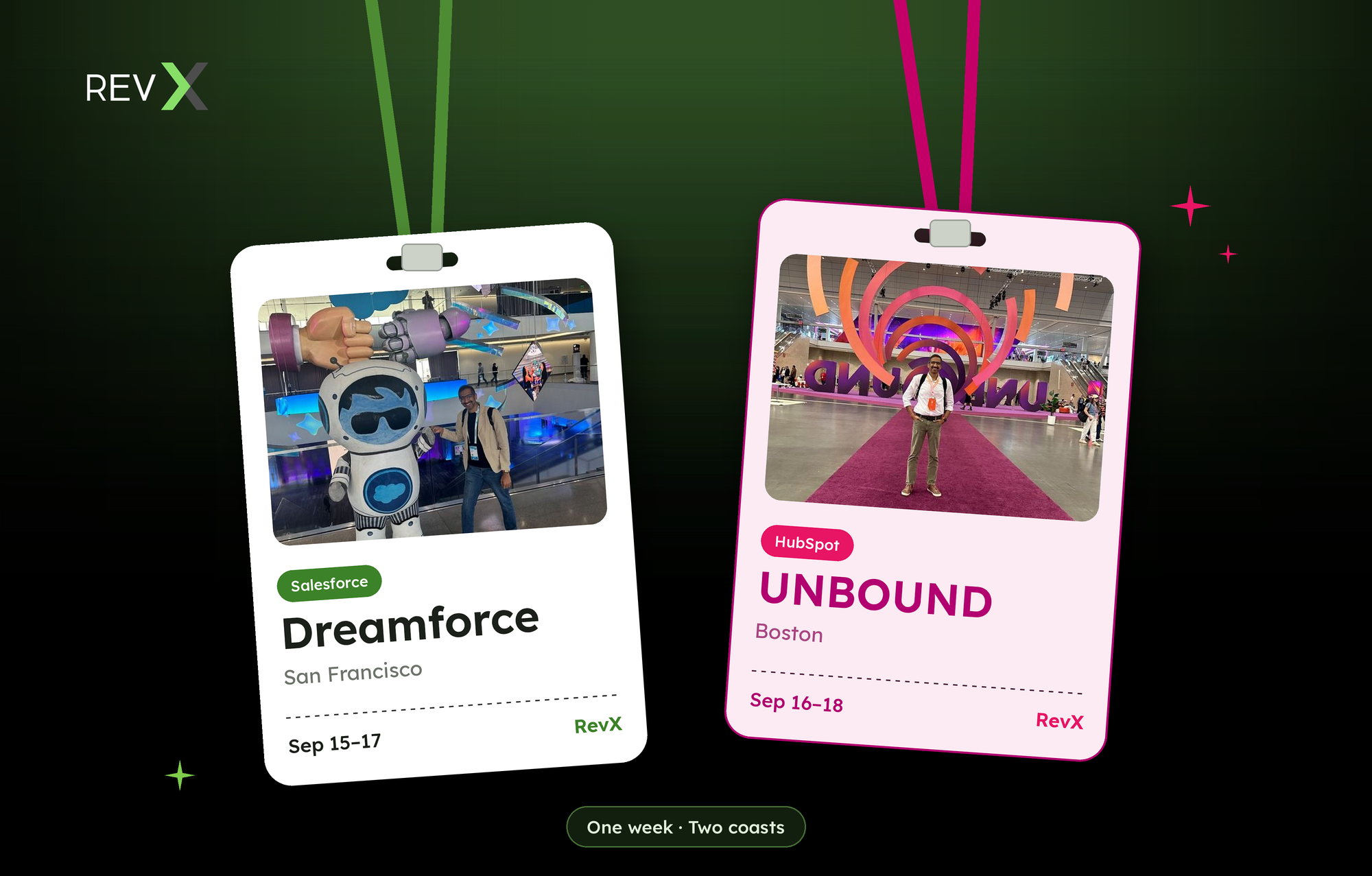
Dreamforce: Salesforce is building the enterprise brain
Dreamforce this year wasn't about one flashy product. It was about architecture. Salesforce's big idea — they're calling it AIforce — is that the interface itself should disappear. Instead of people clicking through screens, AI agents work the platform directly, wherever your team already is: Slack, Claude, or Salesforce itself. Marc Benioff's framing in the keynote was pointed: the "SaaSpocalypse" narrative — the idea that AI kills traditional software — is, in his words, "crazy nonsense." His actual argument was narrower and more interesting: most of the value AI needs is already trapped inside the customer data enterprises have spent twenty years building in Salesforce. The job isn't to replace that data, it's to unlock it.
Three announcements backed that theme up:
The Fin acquisition
Salesforce closed its $3.6B acquisition of Fin (the AI customer service agent, formerly Intercom) on September 10 — right before Dreamforce. Fin runs across live chat, email, WhatsApp, SMS, voice and Slack for over 30,000 companies, with a 76% average resolution rate. It slots in next to Agentforce as the fast-deploy option, versus Agentforce's deep-customization path — Salesforce is now offering both ends of that spectrum instead of picking one.
Revenue Cloud consolidation
Salesforce folded catalog and pricing, quoting and contracts, order management, asset management, metering, and billing into a single system — now rebranded Agentforce Revenue Management — and picked up metering platform m3ter to handle usage-based pricing. The pitch: revenue operations broke because it's been run on disconnected systems and custom code for a decade, and that's no longer viable when you're supporting subscriptions, usage-based, and outcome-based pricing at once.
Claudeforce
This is the one that actually got me fired up. Salesforce and Anthropic went further into open beta on giving Claude direct access to Salesforce workflows and prebuilt sales skills. RevX had already been building on Claude before this was ever announced. Watching Salesforce validate that bet at this scale, on stage, at Dreamforce — that's the moment that got me to commit fully to this direction for the next 12 months.
UNBOUND: HubSpot is building momentum
UNBOUND felt like a completely different event, and that's the point. Where Dreamforce was heads-down on infrastructure, UNBOUND ran on community energy — the hallway conversations, the partner meetups, the sense that this ecosystem is still small enough that you actually run into the same people twice in one day. The partner ecosystem itself has become a real moat for HubSpot; it's not just a software company anymore, it's a network.
Breeze becomes the whole platform, not a feature on top of it
On product, the headline is that HubSpot stopped treating AI as a feature and started treating it as the foundation. The standalone "Breeze" branding for agents and studio tools is going away — folded directly into what HubSpot now calls the Agentic Customer Platform, built around context, action, and coordination layers. Worth being precise here: it's not a full sunset. The Breeze Assistant copilot keeps its name and actually got upgraded — more autonomy, memory, and it now works inside ChatGPT too. What's being retired is the separate "Breeze" label on the agent-building tools, folded into the core platform. As HubSpot put it: AI isn't a layer anymore, it's the whole product.
First CRM integrated with ChatGPT Ads
The other announcement worth calling out: HubSpot became the first CRM integrated with ChatGPT Ads. Ads bought inside ChatGPT can now be informed by HubSpot's own audience data, and leads flow back into HubSpot for attribution — closing a loop that's been missing since people started researching purchases inside LLMs instead of search engines.
Salesforce vs. HubSpot: same war, different battlefield
Put the two events side by side and the split is obvious:
- Segment. Salesforce is enterprise. HubSpot is mid-market and the lower end of enterprise. That's not a knock on either — it's who actually buys each platform.
- Depth vs. speed. Salesforce's CRM and customer-data functionality runs deeper — the governance, the trust layer, the "zero data retention" language Benioff kept repeating. HubSpot optimizes for a company getting value fast, without needing a platform team to run it.
- What each conference actually was about. Dreamforce was a tech and architecture event. UNBOUND was a demand-gen and lead-gen event. That's not incidental — it's a direct signal of who's in the room. Enterprise buyers show up to evaluate infrastructure. Mid-market buyers show up to find their next win.
- Two different AI bets. Both platforms are all-in on AI, but the philosophy diverges. Salesforce is building a governed control plane — multi-model by design (Claude plus their own model, Koa, built with Nvidia), with trust and oversight as the selling point. HubSpot is building for speed and usability, betting that clean, current context matters more than heavyweight governance for the buyer they serve.
I'm not the only one who saw it this way — one of the better independent write-ups on both events landed on almost the same read: different buyer profiles, same underlying bet on agentic AI, and the real competition isn't between Salesforce and HubSpot, it's about who owns context and governance as the durable layer models plug into.
They're not rivals. My POV: they're the Avengers of customer data.
Here's my actual takeaway, offered as one guy's read after two badges and not much sleep, not as gospel: Salesforce and HubSpot aren't fighting for the same customer, so stop reading their announcements as a head-to-head. Salesforce is building the brain for companies that have outgrown simplicity. HubSpot is building the engine for companies that haven't yet — or don't want to. A company's data and go-to-market needs migrate between these two worlds as it scales, and most of the RevOps problems I see are stitching-problems at exactly that seam.
That's what RevX spends its time on: helping teams make both ecosystems talk to each other instead of picking a side.