

 Salesforce
 HubSpot
 Claude
.png?width=58&height=58&name=Frame%202087327944%20(1).png) GA4
GA4
.png?width=58&height=58&name=Frame%202087327944%20(2).png) Marketo
Marketo
.png?width=58&height=58&name=Frame%202087327944%20(3).png) Audit Fox
Audit Fox
 Services


“Great things in business are never done by one person; they’re done by a team of people.” - Steve Jobs.
Your buyers jump between devices, channels, team touchpoints, partner ecosystems, and dark social communities. What if I told you that your attribution model is lying to you, and it’s not even its fault!
Traditional multi-touch attribution (MTA) was built for a simpler internet. A world where cookies tracked everything, journeys were linear, and “first touch vs. last touch” didn’t feel like a philosophical debate.
That world is gone, truly.
Today, buyers research anonymously, engage indirectly, avoid forms, listen to podcasts, see influencer posts, ask peers in Slack groups, and make decisions long before anyone sees a UTM tag.
Ironically, companies are still using attribution models that treat every touch like a clean, traceable breadcrumb.
The shift happening now is about replacing rigid rules with adaptive intelligence. It’s about the attribution that learns, not assigns.
AI doesn’t take care of patterns, which is the real influence hidden inside behavior sequences, timing, persona differences, partner touches, and thousands of micro-signals that no human model can detect.
And that’s why AI-driven attribution is on its way to replace the traditional models. Are you ready?
Why Multi-Touch Attribution Was Never Built for Modern GTM
Multi-touch attribution (MTA) was a clever idea… for maybe 2010. Back then, buyers clicked ads, filled out forms, downloaded PDFs, and followed the kind of predictable funnel paths you could diagram on a whiteboard.
It’s astonishing how AI is transforming marketing attribution in 2025.
Because today’s buyer journey is evolving rapidly, and none of the modern touchpoints truly show up cleanly in an attribution report, yet all of them shape the outcome.
MTA is not “bad”; it’s that it was built on assumptions that no longer exist.
The first flaw: MTA assumes journeys are linear
Modern GTM motions are nonlinear, multi-threaded, and often anonymous.
A single deal might involve:
- 7+ buying committee members
- interactions across ads, SEO, email, outbound, and partner channels
- conversations in dark social where no tracking pixel can follow
But MTA still distributes credit as if buyers follow three neat touches. They don’t, and they never did.
The second flaw: MTA overweights what’s trackable, not what’s influential
If a UTM can’t capture it, traditional models ignore it. But the most influential moments today, peer recommendations, podcast mentions, and Slack intros are inherently untraceable.
💡Learn how to build and use UTM parameters in HubSpot.
When attribution rewards only what tools can see, budgets start flowing to the wrong channels, and teams start optimizing for the wrong signals.
The third flaw: MTA breaks under modern privacy rules
With cookies dying, iOS blocking tracking, and tools obscuring user-level data, MTA is dealing with partial visibility at best.
AI attribution thrives in partial environments because it learns patterns instead of requiring perfect tracking.
MTA doesn’t reflect buyer behavior, but the limitations of the model. Which is exactly why the companies clinging to MTA are optimizing their GTM strategy using a map that no longer matches the territory.
Key takeaway: Traditional attribution is failing because it was built for a world that no longer exists. Modern GTM needs intelligence, not rules. AI is the first attribution model capable of delivering that.
How AI attribution works (and why it sees what humans can’t)
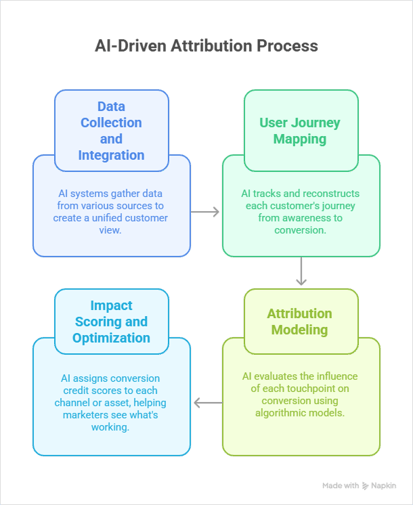
While the traditional attribution models count touches, the AI attribution understands influence.
Instead of distributing credit based on static percentages or predetermined shapes (first-click, last-click, U-shaped, W-shaped), AI attribution analyzes patterns across millions of interactions to determine what truly moved the buyer forward (not just what got recorded).
This shift takes attribution from being a reporting exercise to a decision-making engine.
AI reads patterns humans never notice
To a human analyst, two buyers may look identical in the CRM. However, to an AI model, they’re completely different based on hundreds of micro-signals, such as:
- the order in which they engaged with content
- the timing gaps between touches
- the intensity of certain interactions
- the combination of channels they used
- the persona-level behavior of their buying committee
AI looks beyond what happened as it learns what usually leads to a closed deal, even when humans can’t articulate the logic.
💡Discover how AI-powered personalization at scale is redefining Marketing Ops
AI learns influence from partial data
This is where AI attribution becomes game-changing. Traditional models need clean UTM trails, but AI models don’t.
Even when data is incomplete (which it always is), AI fills gaps using:
- pattern recognition
- behavioral inference
- similarity modeling
- probability scoring
It’s why AI can recognize that a prospect who never clicked anything was still influenced by a webinar campaign or a partner referral based on downstream behavioral similarities to thousands of prior buyers.
You can’t do that with a spreadsheet.
AI models evolve as your GTM evolves
Traditional attribution is static by design. Change the buyer journey, and your model becomes outdated. AI attribution adapts fast.
It learns from:
- market shifts
- ICP changes
- new channels
- partner motion impacts
- PLG or enterprise shifts
- macroeconomic behavior changes
Your attribution literally gets smarter as your business grows.
This is why AI attribution is a replacement and not merely an upgrade
It changes the fundamental unit of understanding from “which touch got credit?” to “what sequence of behaviors reliably creates revenue?” That’s the difference between describing the past… and shaping the future, and hence, you go from reactive to predictive RevOps.
Source: USERMAVEN
Key takeaway: AI attribution uncovers the truth by revealing the real influence behind revenue outcomes, learning patterns no human-defined model could ever capture
The revenue impact: When AI replaces assumptions with truth
When teams stop guessing which channels drive revenue and start knowing, everything changes. AI attribution rewires how budget, people, and strategy decisions get made.
It transitions from being a “better attribution model” to a revenue multiplier.
Because once AI reveals the actual drivers of pipeline, teams stop optimizing for vanity metrics and start investing in what measurably accelerates deals.
AI eliminates the budget wars (because the evidence is objective)
AI breaks the deadlock, aligning marketing, sales, partnerships, and finance for smarter, data-driven decisions.
💡Here’s an insightful resource: How HubSpot-Salesforce integration fuels sales-marketing alignment
Because instead of arguing based on anecdotal wins or last-touch bias, AI quantifies the probabilistic contribution of each touch across the entire journey. And suddenly, decisions that used to take weeks become obvious.
Budgets get reallocated to the channels that consistently produce high-quality pipeline, not just high-volume leads.
AI uncovers hidden revenue drivers that traditional models never see
Every GTM engine has undervalued channels that quietly drive massive influence but never get credit.
AI attribution exposes them.
- A partner touch that increases win-rate by 18%
- A mid-funnel content sequence that shortens sales cycles by 12 days
- A webinar series that boosts deal size among ICP accounts
- A LinkedIn impression pattern that predicts SQL conversion
Traditional attribution can’t even detect these patterns. However, AI models surface them within weeks. For the first time, Ops leaders can clearly see which motions accelerate deals, not just which ones log the most activity.
AI clarifies where revenue is leaking, and tells how to stop it
Because AI models are probabilistic, they detect:
- stages with declining conversion probability
- channels with diminishing marginal returns
- personas that respond poorly to certain motions
- partner programs that look busy but produce no real impact
This kind of detection normally takes quarters, but AI surfaces it instantly. And fixing these micro-leaks is often what transforms a flat pipeline into a predictable revenue machine.
Key takeaway: AI attribution turns GTM from opinion-driven to evidence-driven.
By revealing the true levers behind pipeline velocity, deal quality, and revenue yield, AI gives leaders the clarity to scale what works (and stop funding what doesn’t).
Preparing for the Shift: What GTM teams must do now to unlock AI-driven attribution
Here’s what you need to do today to be AI-ready:
Fix the data foundation, AI can’t learn from chaos
AI attribution thrives on patterns. It needs:
- consistent lifecycle stages
- unified definitions of leads, opportunities, and conversions
- clean owner assignments
- synced marketing, sales, and partner systems
If your CRM contains duplicates, outdated lifecycle logic, or ambiguous fields, your AI model will spend more time unlearning noise than learning signal.

This is where RevOps becomes the hero by architecting systems that stay clean.
Shift measurement from lead volume to pipeline contribution
AI attribution doesn’t optimize for MQL totals or landing page conversions.
It optimizes for:
- win-rate lift
- deal size lift
- pipeline velocity
- conversion probability
The ones who will benefit the most from AI are the ones who stop measuring activity and start measuring impact.
This often requires rewriting your dashboards, KPIs, and incentives. But once you do, everything becomes clearer.
Build an experimentation culture that AI can learn from
AI attribution improves every time your team runs controlled experiments.
If every campaign, outbound motion, or partner initiative looks like a one-off, AI can’t distinguish signal from noise.
But when RevOps introduces:
- controlled tests
- sequencing variations
- channel rotations
- persona-specific messaging trials
…AI begins to uncover powerful patterns you weren’t even looking for.
This is where AI stops being an analytics tool and becomes a performance engine.
💡Here’s how HubSpot X ChatGPT will save you hours of CRM data analysis
Prepare for a world where attribution becomes predictive (and not merely historical).
The real value of AI attribution is, it doesn’t just explain why you won but predicts what will make you win next.
Imagine:
- forecasts that adapt daily
- budget allocation that recalibrates itself
- outbound sequences that update based on intent signals
- partner influence models that evolve as ecosystems shift
- campaigns redesigned before performance declines
Thus, AI attribution becomes your GTM autopilot, or a layer that continuously corrects drift and accelerates performance.
What's truly remarkable is that most teams aren't prepared for that level of intelligence yet. This creates a unique opportunity if you're ready to dominate the market.
Key takeaway: AI attribution is a revenue transformation. Preparing for it requires better data, clearer KPIs, stronger experimentation, and a RevOps function capable of orchestrating it all.
Bottom line is, the companies that still debate attribution models are fighting yesterday’s battle.
The future belongs to teams that let AI reveal the truth.
The million-dollar question, though, is, if your AI could pinpoint the 20% of your GTM strategy that drives 80% of your revenue, are you ready enough to take action on it?

.png?width=352&name=resized_image_915x514%20(4).png)