

 Salesforce
 HubSpot
 Claude
.png?width=58&height=58&name=Frame%202087327944%20(1).png) GA4
GA4
.png?width=58&height=58&name=Frame%202087327944%20(2).png) Marketo
Marketo
.png?width=58&height=58&name=Frame%202087327944%20(3).png) Audit Fox
Audit Fox
 Services

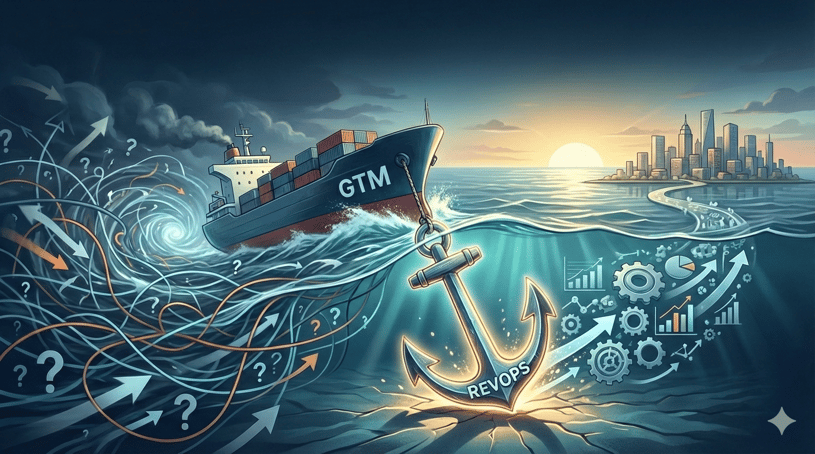
Your Monday morning started with a Slack message from the VP of Sales: "Why are we only at 2.1x pipeline coverage when marketing says lead volume is up 40%?"
By 10 AM, the marketing leader fired back with screenshots showing MQLs hitting target while the sales team sits on unconverted opportunities. Meanwhile, the customer success team notes that they're overwhelmed with poorly-qualified accounts that churn within 90 days.
And you, the RevOps professional caught in the middle, realize this isn't merely a communication problem but a structural one as well.
Irony is, everyone's moving fast, but nobody's moving together.
What’s actually happening is:
- Marketing defines "qualified lead" as anyone who downloaded two assets.
- Sales defines it as a prospect with a confirmed budget and a three-month buying window.
- Customer Success inherited the mess from both onboarding accounts that were never properly vetted.
Thus, the three departments have contributed to a catastrophically misaligned revenue engine by measuring different things and labeling them by the same name.
This is the daily reality for a lot of RevOps professionals as they inherit chaos.
The organizations that escape this cycle are building forcing functions that make misalignment impossible to hide.
- They're replacing quarterly scrambles with predictable execution rhythms where teams know exactly when decisions get made and how work flows.
- They're using AI tools to automate the 10-15 hours of weekly pipeline hygiene and forecast reconciliation that currently prevent strategic work.
- They're documenting everything in centralized systems that transform "Sarah knows how this works" into institutional knowledge that survives turnover.
So, what if the path from "everyone's confused" to "everyone's executing" wasn't about working harder, but about building smarter systems that make misalignment visible before it becomes a crisis?
When Everyone's Moving Fast but Nobody's Moving Together
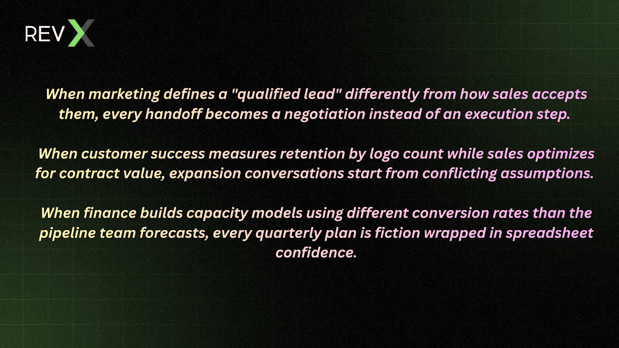
The hidden costs compound quickly as RevOps professionals have to spend weeks reconciling conflicting reports, explaining discrepancies between systems, and mediating debates about whose numbers are "right."
Industry benchmarks show this isn’t just a RevOps problem: over the past two decades, execution speed on large initiatives has declined by ~20%, average delivery slippage has nearly doubled to ~18%, and cost competitiveness has steadily eroded.
The real problem is that they don't realize they're operating in different realities:
- Pipeline stage definitions that exist only in individual memories, not documented systems
- Conversion rate assumptions are buried in personal spreadsheets instead of shared models
- Lead handoff protocols that live in Slack threads and tribal knowledge rather than centralized workflows
- Success metrics that each department defines independently, optimizing for local wins that create global dysfunction
Collaboration workshops won't fix this. Nor will a meeting where everyone nods enthusiastically, then returns to their desk and continues using their own definitions.
The solution is establishing a single source of truth that removes interpretation from execution.
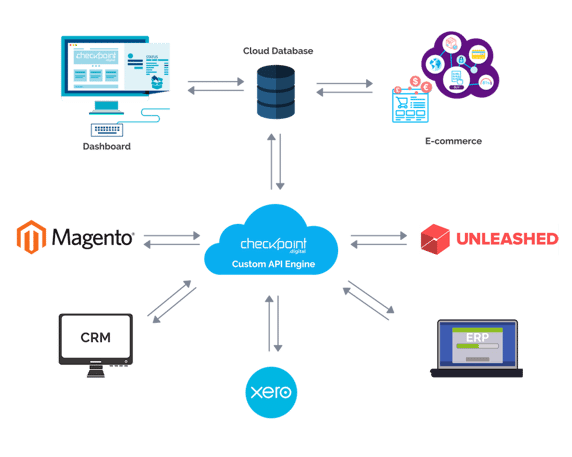
An example of a single source of truth (source: Hare Digital)
Without explicit documentation of what "qualified" means, what triggers a handoff, and how success gets measured across the entire revenue engine, you're not managing a GTM strategy.
Rather, you're simply mediating between competing interpretations of reality, where every cross-functional interaction requires translation and every handoff point becomes a potential failure mode.
The breakthrough insight: Most "people problems" in GTM execution are actually systems problems in disguise.
When you eliminate structural ambiguity, the majority of the interpersonal friction disappears because teams finally execute against the same playbook instead of defending their territory.
 Key takeaway: RevOps transforms alignment from a personality-dependent negotiation into a system-enforced reality. It does so by establishing the definitional precision and transparency mechanisms that make invisible friction visible before it becomes a crisis.
From Quarterly Scrambles to Predictable Execution Rhythms
The most damaging pattern in GTM operations is the relentless cycle of mid-quarter pivots, last-minute forecast adjustments, and emergency pipeline reviews that train teams to expect chaos.
RevOps breaks this cycle by establishing predictable execution rhythms where teams know exactly when decisions get made, who owns each input, and how their work connects to the broader revenue engine.
The transition begins with standardizing three core planning cadences that create systematic visibility before problems escalate.
- Weekly pipeline reviews shift from blame-oriented fire drills to data-driven health checks that surface velocity changes and coverage gaps while there's still time to respond.
- Monthly forecast reconciliation replaces end-of-quarter surprises with structured checkpoints where sales, marketing, and customer success align on capacity constraints and conversion assumptions using shared definitions.
- Quarterly planning cycles establish forcing functions like mandatory input deadlines, required sign-offs, and scheduled conflict resolution sessions that create alignment through process rather than waiting for consensus that never arrives.
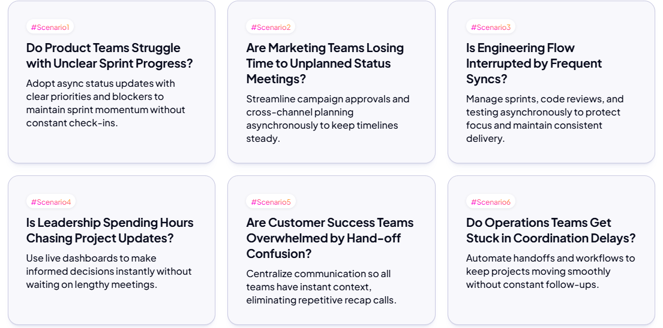
Source: ClickUp
Transparency mechanisms transform these rhythms from calendar events into strategic decision points.
Documented SLAs codify handoff protocols and response time expectations, converting "we thought you were handling that" conversations into clear accountability frameworks.
Visible capacity models quantify team bandwidth and workload distribution, making it impossible to add initiatives without acknowledging the trade-offs required to deliver them.
The significant shift happens when teams stop managing to lagging revenue outcomes and start monitoring leading indicators that provide a 30-60 day warning.
If your velocity is slowing in mid-funnel stages, then that's a signal to investigate qualification criteria or enablement gaps before deals stall completely.
Key takeaway: While predictable execution rhythms don't eliminate hard decisions, they surface them early enough to make thoughtful choices instead of desperate compromises.
When teams know the cadence, they can prepare the inputs; when they trust the process, they can debate the strategy.
Reclaiming Strategic Hours Through Intelligent Automation
Research from McKinsey and other firms suggests that up to 30% of current work activities could be automated by 2030, unlocking roughly 12 additional productive hours per employee each week.
This is a clear signal that manual, reactive operating models no longer scale.
 The true cost is the compound effect of never building the preventive systems that would eliminate these recurring breakdowns.
- Purpose-built AI tools automate the tactical busywork that consumes your capacity without replacing the strategic judgment that defines RevOps expertise.
- Pipeline hygiene automation detects duplicate records, incomplete required fields, and stalled opportunities before they corrupt forecast accuracy.
- Forecast anomaly detection flags sudden velocity changes or coverage gaps that warrant investigation, surfacing the signal from noise so you focus on meaningful pattern analysis rather than spreadsheet archaeology.
- Workflow triggers execute routine handoffs and notifications based on verifiable stage criteria, eliminating the manual coordination that currently lives in your inbox and Slack threads.
The distinction matters. Automation should handle repetitive execution while amplifying your strategic capacity, not becoming another system that requires constant maintenance.
Consider the RevOps leader who implemented automated pipeline scoring that flags deals sitting in the "Negotiation" stage beyond historical velocity thresholds, reclaiming 6 hours of weekly manual review while improving forecast accuracy by 12%.
The AI didn't replace the judgment about which deals warrant intervention, but also eliminated the tedious work of identifying them so she could focus on the conversations that actually move revenue.
The automation maturity progression follows a specific sequence that builds capability without creating technical debt:
- Month 1-2: Implement data hygiene automation (duplicate detection, required field validation, format standardization) that creates the clean foundation required for reliable reporting
- Month 3-4: Deploy workflow triggers for routine handoffs (lead assignment, opportunity stage transitions, renewal reminders) that eliminate coordination overhead
- Month 5-6: Add forecast anomaly detection and pipeline health monitoring that surfaces strategic risks requiring human judgment
- Month 7+: Build predictive analytics for capacity planning and revenue forecasting that transforms historical patterns into forward-looking intelligence
Burnout prevention becomes a systematic capacity planning problem when automation makes workload visible and quantifiable.
Instead of heroically absorbing every new initiative until exhaustion forces a breaking point, you build models that calculate team bandwidth, track capacity allocation across projects, and trigger early-warning alerts when commitments exceed available hours.
Key Takeaway: Reclaiming 10-15 hours weekly through intelligent automation is about redirecting capacity from tactical fixes to the systematic design work that prevents future breakdowns and builds institutional capability.
The RevOps Maturity Framework: Building Execution Discipline That Scales
The transition from GTM dysfunction to operational excellence is a sequential capability build where each maturity stage creates the credibility and infrastructure required for the next.
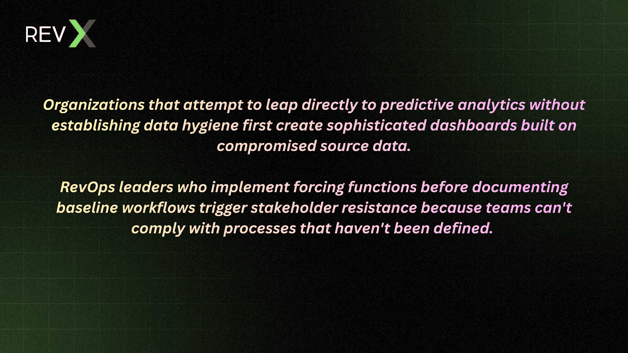
The maturity progression matters because skipping foundational layers guarantees failure at advanced stages.
The Four-Stage Maturity Model builds systematic execution discipline through measurable capability layers:
- Stage 1 (Months 1-3): Single source of truth foundation
Establish unified definitions for pipeline stages, lead qualification criteria, and handoff protocols in centralized documentation that removes interpretation from execution.
Implement data hygiene automation that validates required fields and flags anomalies before they corrupt forecasts
- Stage 2 (Months 4-6): End-to-end workflow mapping:
Document complete cross-functional processes with explicit trigger conditions, ownership swim lanes, and success criteria for every GTM handoff.
Create forcing functions (mandatory input deadlines, required sign-offs, scheduled conflict resolution) that generate alignment through structure rather than consensus
- Stage 3 (Months 7-9): Leading indicator intelligence:
Build dashboard systems that surface pipeline coverage ratios, velocity trends, and conversion anomalies with 30-60 day warning; shift stakeholder focus from lagging revenue panic to proactive course-correction based on early signals
- Stage 4 (Months 10-12): Predictive capacity planning:
Implement AI-driven forecasting that models scenario impacts across the revenue engine; deploy capacity allocation systems that quantify team bandwidth and trigger alerts when commitments exceed available resources
The forcing function templates create structural alignment when stakeholder consensus fails. Mandatory planning input schedules with explicit deadlines eliminate the "I didn't know you needed that" delays that derail quarterly planning.
- Documentation frameworks transform tribal knowledge into institutional assets through three systematic layers. Process documentation captures the "what" and "when" of workflows in searchable repositories that survive turnover.
- Decision logs record the "why" behind strategic choices, so future teams understand context rather than blindly following outdated protocols
- The cross-functional workflow architecture eliminates "that's not my job" dynamics through explicit accountability mapping.
- Brand alignment emerges not as a separate initiative but as the natural outcome of systematic maturity progression.
When teams operate from unified definitions, execute through documented workflows, monitor shared leading indicators, and plan against visible capacity constraints, departmental silos dissolve because the structural friction that created them no longer exists. T
Key Takeaway: RevOps maturity doesn’t need heroic transformation efforts as it’s built through sequential capability layers where each stage creates the credibility and infrastructure required for the next.
Organizations that implement the four-stage maturity framework create a self-reinforcing execution discipline that becomes a competitive moat.
The bottom line is, RevOps is the system that makes GTM chaos impossible to ignore.
Clear definitions, enforced workflows, and early signals eliminate the need for heroics in execution.
The real question is: what breaks first when ambiguity is no longer allowed to hide in your revenue engine?