

 Salesforce
 HubSpot
 Claude
.png?width=58&height=58&name=Frame%202087327944%20(1).png) GA4
GA4
.png?width=58&height=58&name=Frame%202087327944%20(2).png) Marketo
Marketo
.png?width=58&height=58&name=Frame%202087327944%20(3).png) Audit Fox
Audit Fox
 Services


RevOps has never been more active with tighter processes, cleaner systems, and dashboards fuller than ever
But to the majority of leaders, RevOps still struggles to earn the credibility it deserves.
The issue isn’t performance. Companies with RevOps grow revenue significantly faster than those without it, no debate there.
The issue is measurement as RevOps teams struggle to clearly demonstrate how their work impacts revenue outcomes, even when the business is growing. What gets shared instead are generic efficiency stories, such as hours saved, workflows automated, and tickets closed.
Those metrics sound responsible, but they quietly frame RevOps as a support function.
Leadership doesn’t question whether RevOps is busy. They question whether it “moves” the business. When measurement focuses on activity instead of economic impact, confidence gets hampered, budgets tighten, and influence plateaus.
The real cost of the measurement gap is credibility! And once that fades, even strong results struggle to change perception.
RevOps Is Driving Growth, But Can’t Prove It
There’s a growing contradiction inside modern GTM teams. Organizations that invest in RevOps consistently outperform their peers. But many of those same teams struggle to clearly explain their contribution to revenue. Growth is happening, but ownership of that growth feels vague.
Yes, when clients share positive reviews about you, everyone knows the work was fantastic:
However, internally, the connection between that success and the efforts of individual teams often feels unclear. It's easy to celebrate wins, but harder to attribute them to specific actions or strategies.
Industry data reinforces this disconnect. 86% of employees believe that the absence of interdepartmental collaboration contributes to failures in the workplace.
Despite this, fewer teams can point to specific revenue outcomes influenced by RevOps decisions.
The problem is that contribution lives in the background, and while growth is visible, the mechanisms behind it remain diffuse. Likewise, leadership sees improvement, yet struggles to attribute it to specific operational decisions or trade-offs made by RevOps.
💡Discover how AI is transforming marketing attribution in 2025
This creates a measurement vacuum. In the absence of clear revenue-linked proof, RevOps impact gets absorbed into the broader GTM story. After all, the numbers are key!
 A few patterns reinforce this gap:
- Growth is treated as correlation, not as the result of specific RevOps interventions
- Operational wins are described qualitatively, while revenue is discussed quantitatively
- Impact is assumed, not demonstrated, once alignment improves
- Credit diffuses upward, leaving RevOps with influence but limited authority
Over time, this shapes perception. RevOps is seen as the function that enables others to perform, rather than one that directly changes revenue outcomes. The work remains critical, but credibility plateaus because measurement never crosses the line from contribution to causation.
Key takeaways:
- RevOps is closely linked to faster revenue growth, but that link often remains implicit rather than measured.
- When impact stays correlated instead of causal, credibility weakens even as results improve.
When Efficiency Metrics Become a Credibility Trap
RevOps teams often measure what’s easiest to defend. Metrics like time saved through marketing automation, fewer handoffs, faster deal cycles, etc, feel concrete inside Ops teams that pride themselves on execution discipline.
💡A perspective designed to challenge how you think - Kanad & Shreyansh on AI in RevOps, key KPIs, and other insights
The problem is that efficiency metrics speak the wrong language in leadership rooms.
This creates a credibility trap for RevOps:
- Time saved sounds tactical, not strategic
- Automation counts signal activity, not leverage
- Process improvements feel incremental compared to revenue movement
- Efficiency gains are hard to translate into executive trade-offs
Over time, RevOps becomes associated with keeping things running rather than moving the business forward. Even strong efficiency stories struggle to compete with teams that can point to revenue lift, pipeline acceleration, or improved forecast reliability.
The irony is that efficiency does matter. But without an economic wrapper, it stays invisible at the level where credibility is earned. RevOps ends up doing high-impact work while reporting low-impact proof.
A Deloitte study revealed that almost 50% of executives lack trust in the metrics they use to measure performance, highlighting that traditional methods are outdated.
Relying on surface-level efficiency metrics not only obscures potential risks but also contributes to burnout, turnover, and client dissatisfaction. To address this, leaders must shift from tracking activity to focusing on outcome-based visibility.
Key takeaways: Efficiency metrics reinforce operational value but rarely build executive credibility. Without linking work to economic outcomes, RevOps remains positioned as support rather than strategy.
What Leaders Actually Believe: Revenue Signals Over Activity
According to Harvard Business Review, employees at high-trust companies report 74% less stress, 106% more energy at work, 50% higher productivity, 13% fewer sick days, 76% higher engagement, 29% greater life satisfaction, and 40% less burnout than those at low-trust organizations.
That includes leadership trust, and it comes from movement, not volume!
They evaluate impact by watching what changed; whether revenue is moving faster, and forecasts are tightening. These are the signals that shape belief, even when measurement isn’t perfect.
This is where many RevOps narratives quietly miss the mark. Activity-heavy reporting assumes that leaders extrapolate value from effort. In reality, leaders reverse the logic. They look for economic signals first, then ask what enabled them.
A few patterns consistently influence executive belief:
- Revenue acceleration: Not just growth, but speed. It involves lead-closure time, faster movement through pipeline stages, momentum matters more than volume, etc.
- Forecast behavior: Leaders see that when forecasts become stable, it shows control and understanding, which helps build confidence fast.
- Risk visibility: Surfacing downside early earns more trust than celebrating upside late. Leaders reward teams that expose fragility before it becomes failure.
- Repeatability under pressure: When performance holds during market shifts, headcount changes, or demand shocks, leaders infer that systems are doing real work.
These signals share one trait for sure that they are economic, not operational. They don’t describe what RevOps did. They describe what the business experienced as a result.
The implication for RevOps is subtle but powerful. Credibility is earned by shaping the signals leadership already uses to decide where to invest, where to cut, and where to double down.
When RevOps aligns its measurement to those signals, the conversation changes. Updates shift from justification to interpretation. Questions move from “What did you work on?” to “What are you seeing next?”
That’s the moment RevOps stops being evaluated and starts being trusted.
Also, leaders look for evidence that outcomes are changing in economically meaningful ways. Revenue acceleration, forecast stability, and resilience under pressure are all proof that the business is achieving its intended objectives.
Productivity and utilization explain how much work is happening. Effectiveness explains whether the work is working. That’s why executive belief forms around revenue behavior and forecast control, not activity volume.
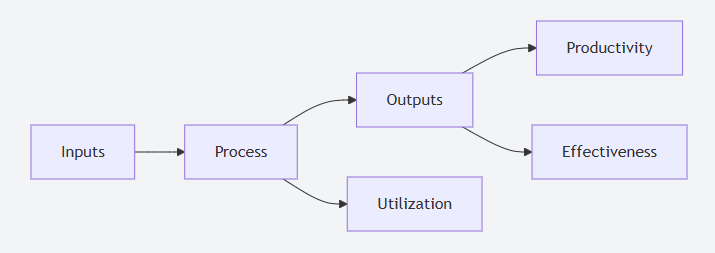
Source: NumberAnalytics
RevOps earns trust when it frames performance through effectiveness metrics that reflect real business impact.
Key takeaways: Leaders form beliefs through revenue behavior, not operational activity. RevOps earns credibility when it reports in the language executives already use to make decisions.
Closing the Measurement Gap: Where Credibility Is Actually Won
Not saying that executives struggle to read dashboards. But they do struggle to trust what those dashboards imply about the future.
When metrics feel disconnected from decision quality, leaders stop asking for more data and start relying on instinct. That’s the moment when measurement quietly loses its influence.
The organizations that escape the data trust trap don’t fix it by adding more dashboards or tightening definitions. They fix it by redesigning how measurement works inside the operating system of the business.
Instead of asking, “How do we report this better?” they ask a more foundational question:
What decisions should this data reliably inform, and what must be true for leaders to trust it?
This shift fundamentally changes how measurement is designed.
They stop optimizing for accuracy and start optimizing for decision clarity
Perfect numbers do not guarantee good decisions. High-performing teams design metrics that reduce ambiguity at moments of choice: hiring, investment, prioritization, or go-to-market shifts.
The goal becomes clarity under uncertainty, not obsessing with mathematical perfection.
They treat data friction as a signal (and not a nuisance)
Instead of smoothing over inconsistencies, mature teams study where friction appears. Repeated debates, constant reconciliations, or “gut check” overrides become diagnostic signals pointing to broken assumptions or misaligned definitions.
These friction points are used as inputs to improve the system, not errors to hide.
They build measurement around decisions (and not departments)
Rather than aligning metrics to org charts, leading teams align them to recurring decisions:
- Where to invest next
- What to deprioritize
- Which risks are acceptable
This reframing makes metrics inherently cross-functional and prevents siloed interpretations.
They design for trust at scale
The advanced organizations stop trying to control every metric centrally. Instead, they design guardrails that allow teams to explore data freely while preserving consistency where it matters.
Trust becomes a system property, not a compliance outcome.
A well-crafted visual board transforms insights into a clear, shared understanding, enabling teams to identify gaps, monitor progress, assign tasks, and stay focused on priorities.
Without this visibility, gaps remain unnoticed. With it, continuous improvement becomes a team effort, clear and measurable.
Here's how Data Point enhances your gap analysis process:
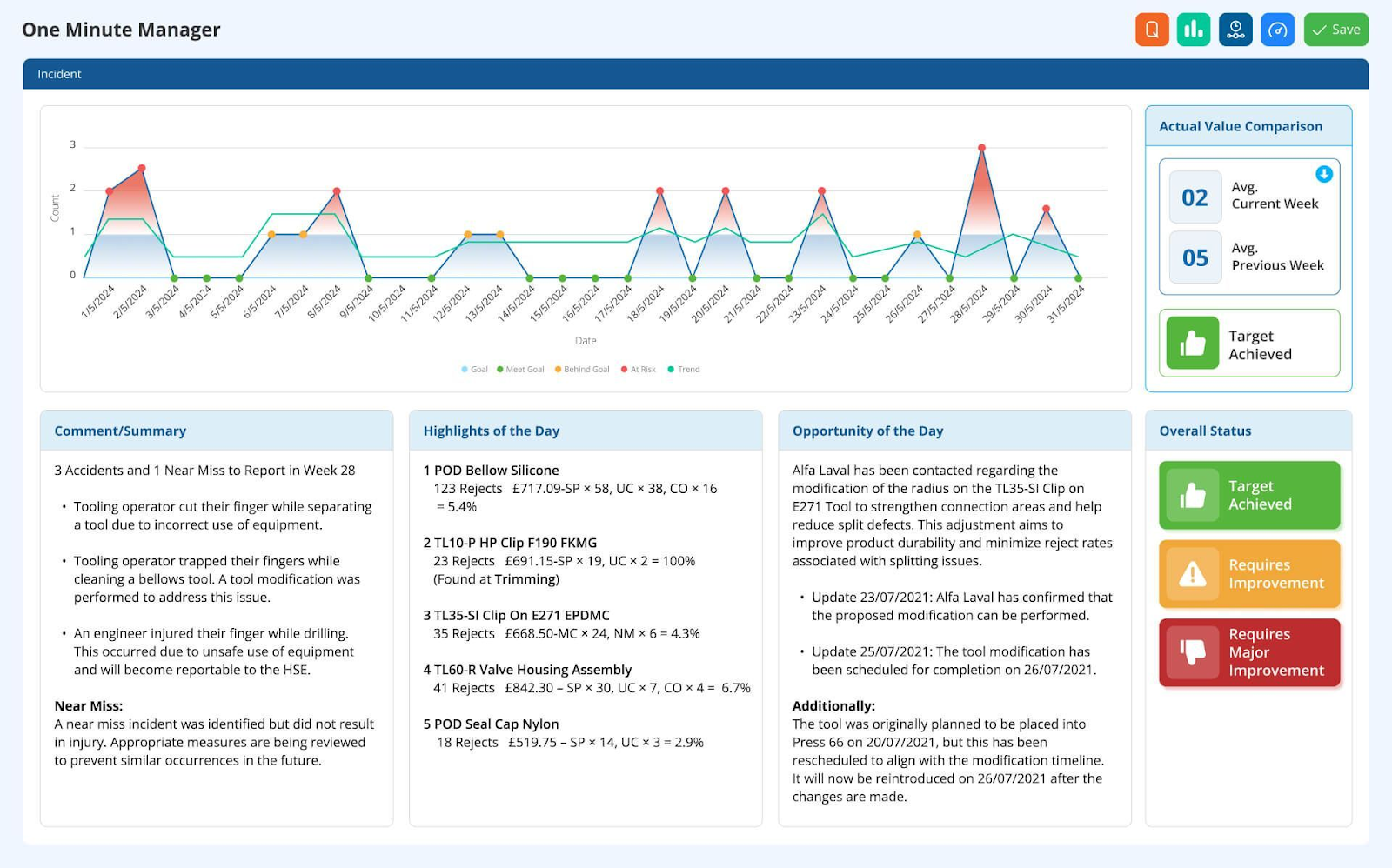
Source: Data Point
The result is a quiet but powerful shift: measurement stops being a reporting obligation and becomes a shared operating language. Leaders, instead of asking whether the data is right, ask “what the data is telling them to do next”.
Key takeaways: High-performing teams fix data trust by redesigning how decisions are supported. When measurement is built around clarity, not control, trust becomes an asset that compounds with scale.
So, the real question now doesn’t revolve around whether your data is accurate, but whether your organization trusts it enough to act without hesitation. Because the moment decisions outpace confidence, the problem becomes bigger than data quality: a leadership risk.



.webp?width=352&name=These%205%20B2B%20Lead%20Gen%20Trends%20-%20Blog%20Image%20(1).webp)