

 Salesforce
 HubSpot
 Claude
.png?width=58&height=58&name=Frame%202087327944%20(1).png) GA4
GA4
.png?width=58&height=58&name=Frame%202087327944%20(2).png) Marketo
Marketo
.png?width=58&height=58&name=Frame%202087327944%20(3).png) Audit Fox
Audit Fox
 Services

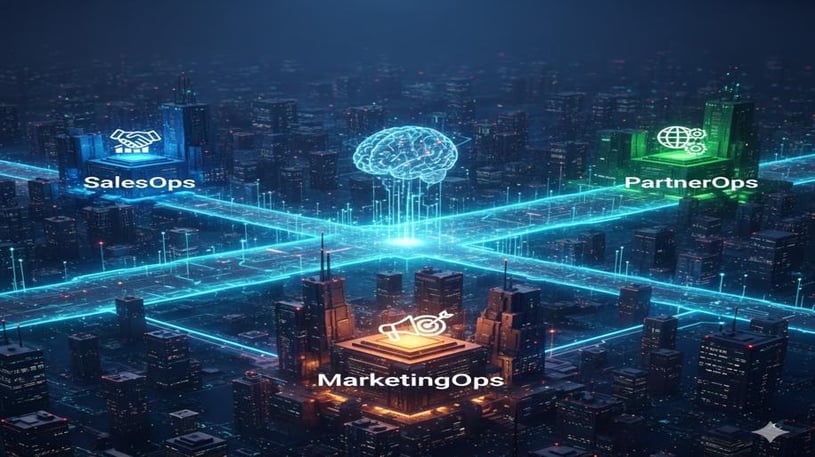
“Great things in business are never done by one person; they’re done by a team of people.” - Steve Jobs.
And yet in most GTM orgs, SalesOps, MarketingOps, and PartnerOps operate more like three separate teams than one.
This results in a GTM engine that runs like a three-legged race at a corporate offsite. It’s chaotic, slow, and full of “alignment meetings” that still don’t fix anything.
The real blocker is the invisible friction created by siloed intelligence.
This is where AI acts as the connective tissue that turns three disconnected Ops functions into one unified GTM system.
Because for the first time, AI can:
- Understand patterns across sales, marketing, and partner motions
- Normalize definitions across the entire revenue engine
- Route leads and opportunities based on probability, not politics
- Predict which channel (direct, marketing, or partner) creates the fastest path to revenue.
💡Discover how predictive analytics is reshaping Marketing Ops for scalable growth
- And expose hidden gaps humans only see months later
The interesting aspect is that, rather than replacing Sales Ops, Marketing Ops, or Partner Ops, AI is revealing how incomplete each of them is without the other two.
After all, in today’s competitive markets, alignment the operational architecture and AI is the bridge.
Why does GTM Ops speak different languages?
Most companies think Sales Ops, Marketing Ops, and Partner Ops are “misaligned.” Reality is, they’re optimized for different realities.
SalesOps lives in opportunity signals, Marketing Ops in engagement signals, and Partner Ops in influence signals. So, none of them speaks the same analytical language, so their systems can’t agree even when the people do.
This creates three fundamental failures:
- Three versions of pipeline truth: one from CRM, one from MAP, one from PRM
- Three different scoring models: lead scoring, deal scoring, and partner attribution
- Three separate execution loops: each running campaigns, cadences, and co-selling motions in isolation
And every time the business scales, these gaps widen because their underlying systems are incompatible by design.
What you may not realize is that humans can align in meetings. Systems can’t. Unless the underlying logic is unified, every Ops function keeps unintentionally optimizing against the others.
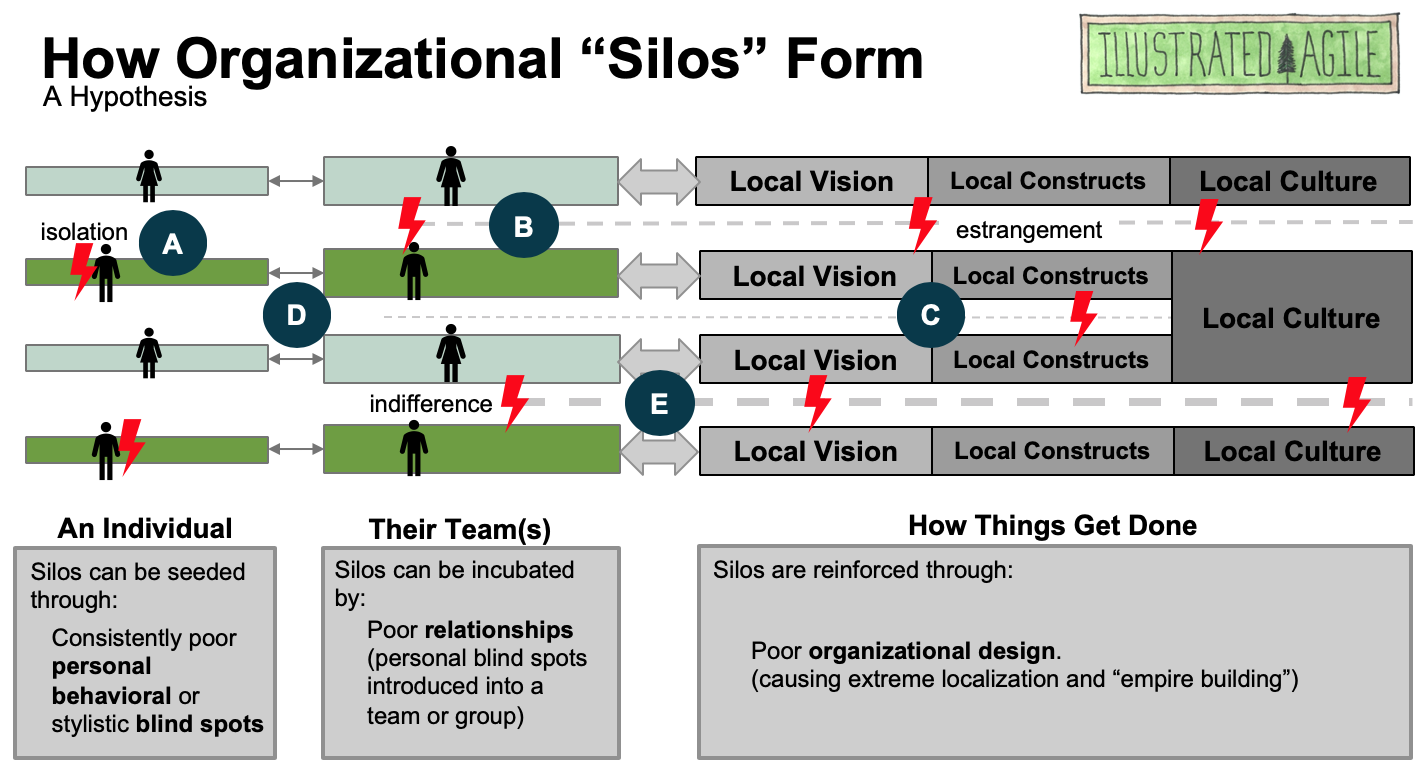
Source: Illustratedagile
This is exactly the gap AI bridges by creating a shared intelligence layer that interprets signals across all three functions.
What AI enables (that RevOps alone cannot):
- Map behavior → intent → influence into a single ontology
- Normalize definitions across systems without rearchitecting them
- Detect relationships between signals that humans can’t manually reconcile
- Build a unified truth layer even when raw data lives in silos
And this is the operational unification that marks the beginning of true AI Ops.
Key takeaways: GTM misalignment stems from fragmented data models, not team behavior. AI acts as a unifying semantic layer, giving SalesOps, MarketingOps, and PartnerOps a shared truth.
💡If you’re up for a new perspective on alignment, this read will definitely be right up your alley - How HubSpot-Salesforce integration fuels sales-marketing alignment.
The rise of the AI-Native Ops Stack (and why it’s not “Automation 2.0”)
You may think they’re “doing AI” because they added an AI chatbot, enabled a predictive score in their CRM, or plugged ChatGPT into their workflows. But that’s not an AI-native Ops stack.
That’s more like “AI glued onto old problems.”
An AI-native GTM engine doesn’t sprinkle AI on top of existing systems. Rather, it re-architects the system so Sales Ops, Marketing Ops, and Partner Ops operate from a shared intelligence layer instead of siloed workflows.
And this changes everything because AI-native Ops isn’t about task automation but decision automation.
Legacy Ops = workflows triggered by static rules. AI Ops = workflows triggered by real-time intelligence
For instance, AI’s role is expanding in software development, from autocomplete to full-scale agents.
AI models have evolved from simple autocomplete tools to powerful agents that assist across the entire software development lifecycle. As of August 2025, models can sustain multi-hour reasoning, working for up to 2 hours and 17 minutes at around 50% confidence, with this capability doubling every seven months.
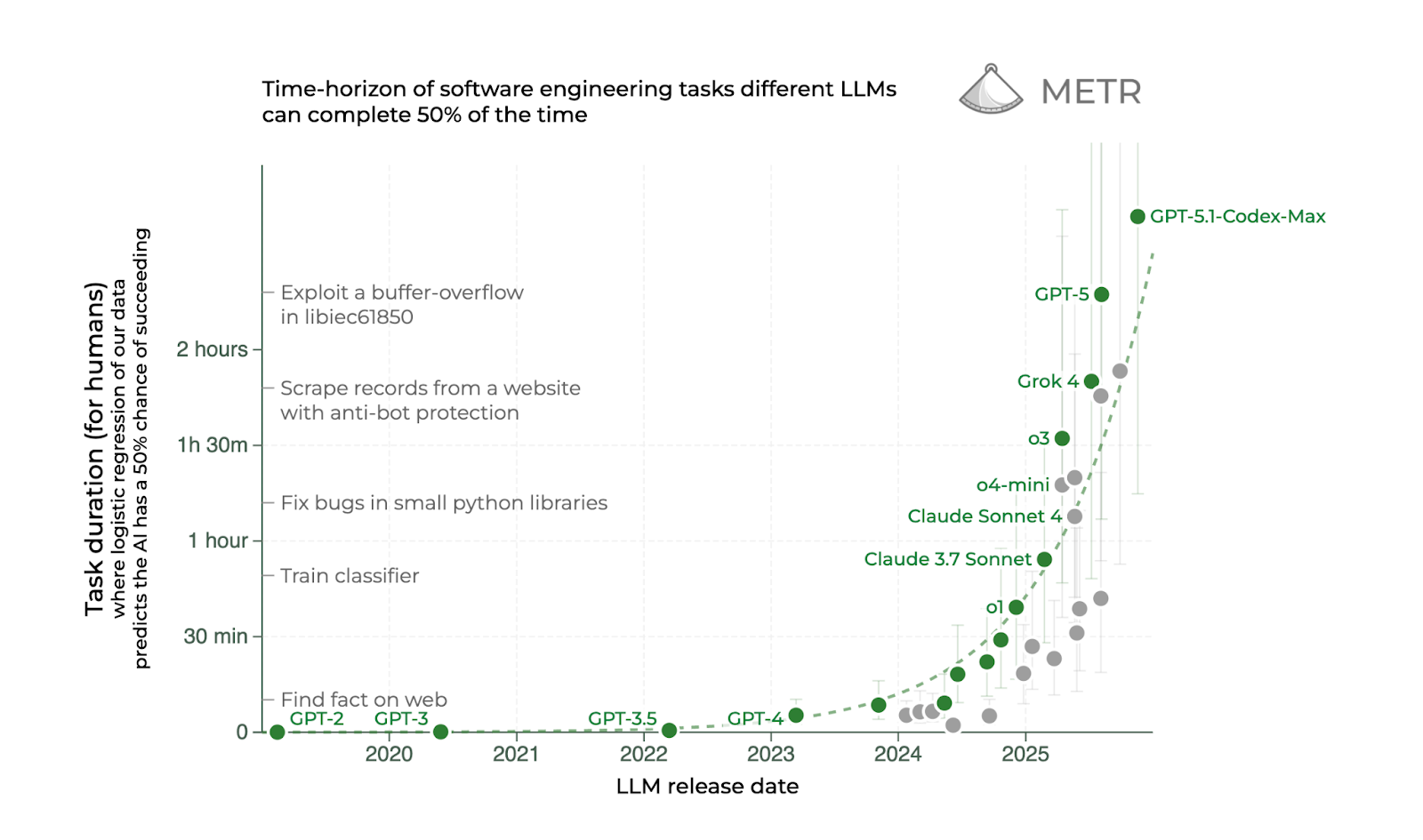
Source: OpenAI
Today’s AI tools handle tasks like planning, design, development, testing, and deployment, enabling developers to delegate entire workflows instead of just generating code, fundamentally transforming the development process.
And talking of automation:
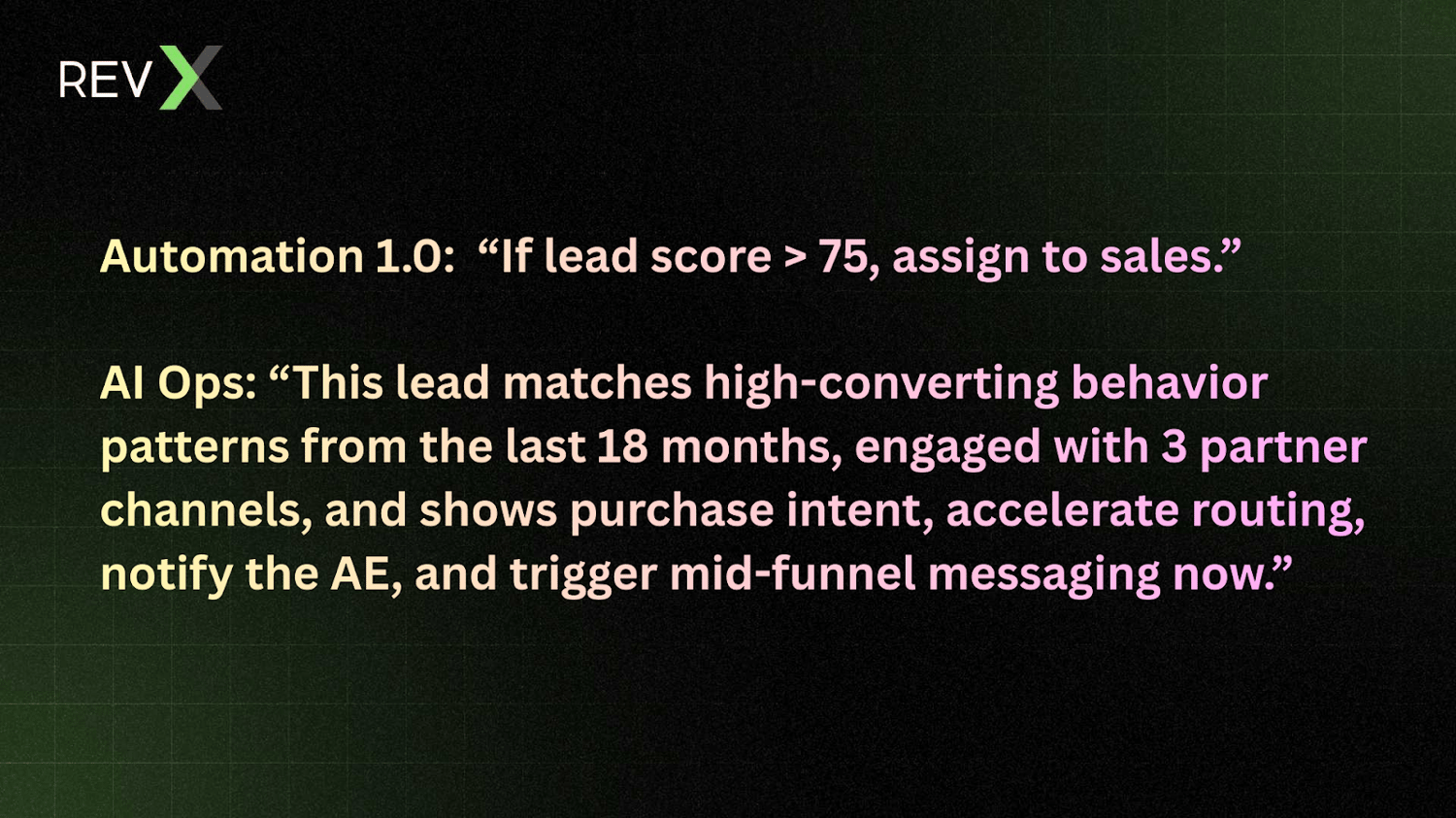
The first one is a rule, while the second one is a decision. This is the layer where RevOps traditionally lived, and now AI just made it 10x smarter.
The AI-native Ops stack creates a “single learning brain” across GTM
Think of it as a central nervous system that constantly absorbs signals from touchpoints like CRM, MAP, partner management tools, web behavior, etc.
And instead of outputting static dashboards, AI outputs:
- recommended actions
- risk alerts
- prioritization cues
- revenue-impact predictions
- spend allocation adjustments
- partner influence indicators
This is the moment the GTM engine stops just being “supported by RevOps” and starts being driven by intelligence.
AI closes the loop between teams with a shared intelligence layer, and marketing, sales, partners, and CS all act in sync for campaigns, sequences, deal support, and churn prevention, adjusting automatically.
Key Takeaway: AI-native Ops is the new operating system. Teams that adopt it run on shared intelligence, win by making faster, smarter decisions across every function.
The AI Ops future: Revenue teams stop reacting and start orchestrating
Collaboration and breaking down silos within organizations are crucial for resilience and strategic alignment. A survey of 739 leaders found that 71% of respondents see strategic risk oversight and scenario planning as key areas where board involvement boosts resilience.
Moreover, 66% of leaders identify open, transparent communication between the board and C-suite as the top factor influencing organizational resilience.
And AI is rapidly becoming this facilitator. If you think AI in RevOps just means “faster reporting” or “smarter workflows”, very respectfully and as a good friend, you still have the 2018 view of AI. 🙂
The real evolution is AI turning GTM from a collection of functions into a coordinated revenue system.
Before AI, every Ops team spent most of its time fixing broken workflows, cleaning data, resolving attribution agreements, etc.
Thankfully, AI Ops flips this model on its head.
Instead of reacting, Ops becomes a real-time orchestrator, and it’s constantly adjusting, optimizing, and predicting without human intervention.
AI generates revenue plays before teams even ask.
If conversions dip in mid-funnel but surge in partner-attributed opportunities, AI doesn’t wait for a meeting. It automatically recommends:
- Shifting budget
- Reassigning SDR capacity
- Tweaking partner incentives
- Adjusting nurture paths
Ops becomes a command center (and not a ticket queue).
AI eliminates “blind spots” entirely.
Historically:
- Marketing can’t see downstream conversion quality.
- Sales can’t see upstream behavior.
- Partner teams can’t see real influence.
But with AI stitching signals together, each function suddenly sees context, not just metrics. Context is what drives intelligence.
AI enables dynamic GTM, where plans update themselves.
Campaigns now adapt mid-flight, forecasts shift daily, ICP definitions evolve weekly, and capacity planning recalibrates in real time. The operating environment never sits still.
This is the moment when RevOps stops functioning as a back-office support layer and transforms into the core revenue operating system powering the business.
And that leads to the biggest shift of all as AI Ops makes GTM predictable, not probabilistic.
Key takeaways: The future of GTM is a unified AI layer orchestrating revenue in real time. AI turns RevOps into a predictive, self-optimizing growth engine.
How AI removes systemic friction that humans can’t fix
For years, GTM teams tried to “align” with meetings, SLAs, shared dashboards, and quarterly workshops.
However, humans cannot solve structural friction created by systems, volume, and speed.
At some point, no amount of communication can keep up with the complexity.
This is where AI steps in to remove the structural friction that makes alignment impossible in the first place.
AI significantly enhances collaboration within teams. A joint study by Lightricks and the American Marketing Association found that 39% of marketers reported improved team collaboration, thanks in part to AI’s ability to streamline workflows and provide creative prompts.
Additionally, 50% of marketers saw time savings in their creative processes, highlighting how AI fosters both individual and team productivity in collaborative environments.
The real breakthrough is that AI neutralizes the root causes of cross-functional waste.
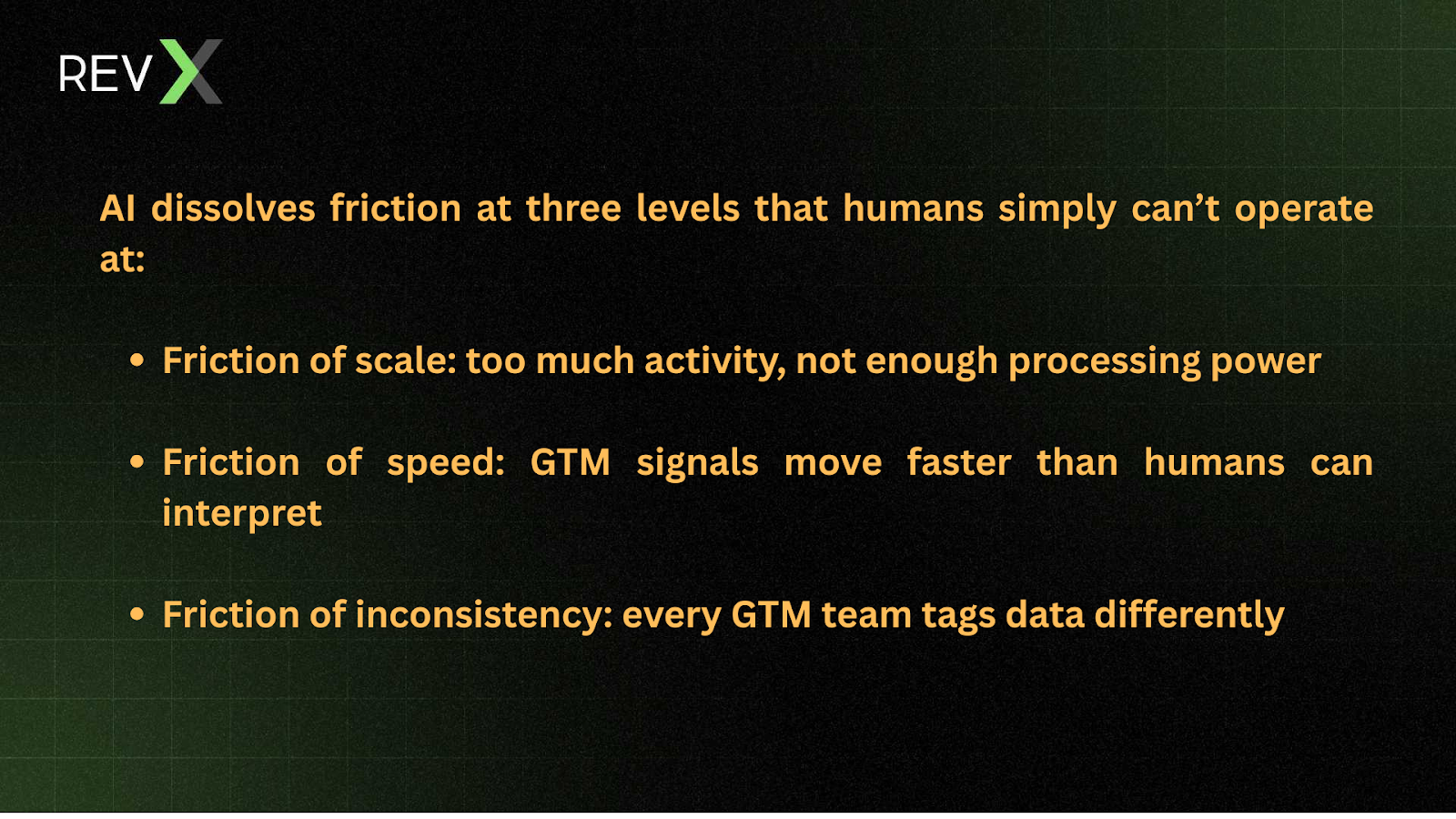
Friction of scale: too much activity, not enough processing power
Sales runs thousands of interactions per week, marketing logs millions of signals, and partner channels create dozens of hidden influence points per deal.
No RevOps team, no matter how good, can stitch this volume into a coherent picture.
But, thankfully, AI can!
Friction of speed: GTM signals move faster than humans can interpret
A human often spots signals only after they’ve already slipped.
By the time you notice stalled leads, shifting intent, underperforming campaigns, or partner influence, the moment has passed.
But AI catches these movements in real time and triggers:
- automated routing
- partner influence alerts
- dynamic nurture switches
- sales nudges
- deal-risk warnings
While humans react, AI anticipates.
Friction of inconsistency: every GTM team tags data differently
Sales calls it a “late-stage deal,” marketing calls it “high-intent,” and partners call it “co-influenced.” Everyone is describing the same thing in different ways.
AI cuts through the confusion by learning patterns instead of labels. It applies one consistent definition, even when humans don’t.
The results in a frictionless GTM motion that feels coordinated even when teams aren’t in the same room.
Here’s what AI enables that no human process ever achieved:
- Unified routing: AI routes leads based on likelihood to convert, not arbitrary fields.
- Cross-functional intent scoring: AI blends marketing engagement, sales signals, and partner influence into a single score.
- Proactive deal support: AI flags deals likely to slip weeks before humans notice.
- Channel auto-optimization: AI shifts budget toward the channels creating a real pipeline, not the ones reporting fake efficiency.
They’re architecture-level changes, not mere efficiency hacks.
Key takeaways: Human alignment breaks the moment system friction exceeds what teams can handle. AI replaces that friction with a shared intelligence layer, making GTM misalignment structurally impossible.
The bottom line is, AI is bringing the scalable limitations of RevOps to the limelight.
All the friction that slowed your revenue engine- limited bandwidth, poor visibility, and noisy signals- AI just wiped out in one sweep.
So, what becomes possible for your revenue engine when the bottlenecks you always assumed were “normal” suddenly disappear?
That’s the frontier AI Ops opens, and most teams haven’t even begun to explore it. Have you?



.webp?width=352&name=AI%20in%20Marketing%20Ops%20-%20Blog%20Image%20(1).webp)