

 Salesforce
 HubSpot
 Claude
.png?width=58&height=58&name=Frame%202087327944%20(1).png) GA4
GA4
.png?width=58&height=58&name=Frame%202087327944%20(2).png) Marketo
Marketo
.png?width=58&height=58&name=Frame%202087327944%20(3).png) Audit Fox
Audit Fox
 Services


Sales–marketing alignment is an illusion that keeps deceiving even the best of revenue teams. Just when they seem to have accomplished it, the illusion collapses at execution. As a result, mismatched incentives, data gaps, and handoffs hamper the revenue impact.
The disconnect is structural, where teams move in the same direction, but their systems, metrics, and financial signals aren’t actually working together.
This is phantom alignment, a state where collaboration looks healthy on the surface, but cracks become evident as soon as the pressure to deliver arises.
The cost shows up in subtle ways.
- Marketing optimizes for volume that sales can’t convert.
- Sales pushes for pipeline quality without visibility into upstream constraints
- Finance sees revenue gaps only after they’ve already hardened.
By the time leadership gets a chance to react, the loss has already occurred.
What makes phantom alignment dangerous is this invisibility. And the systems lack unified metrics and financial instrumentation to surface friction early enough to correct it.
And so, the real question remains: whether your alignment is engineered deeply enough to prevent revenue loss before it happens?
When alignment exists only in meetings and dashboards
The issue lies in how alignment is defined. Most teams align around intent and activity, not around execution mechanics.
Goals are shared, but the paths to reach those goals differ. While marketing optimizes for engagement and volume, sales optimizes for conversion and deal velocity. Each function performs well within its lane, while the system as a whole underperforms.
💡Discover how RevOps can help manufacturing businesses align their KPIs
Phantom alignment typically shows up in familiar ways:
- Shared goals without shared ownership of outcomes
- Dashboards that track activity, not friction
- Regular syncs that don’t resolve structural gaps
- Success is measured in local wins rather than revenue flow
What remains hidden is how often handoffs break, how definitions drift, and how upstream decisions quietly constrain downstream performance.
Phantom alignment thrives where coordination replaces accountability. Teams feel aligned because communication is frequent, yet no one owns the revenue journey end-to-end
When outcomes disappoint, the issue gets framed as execution slippage instead of system design.
Source: Influ2
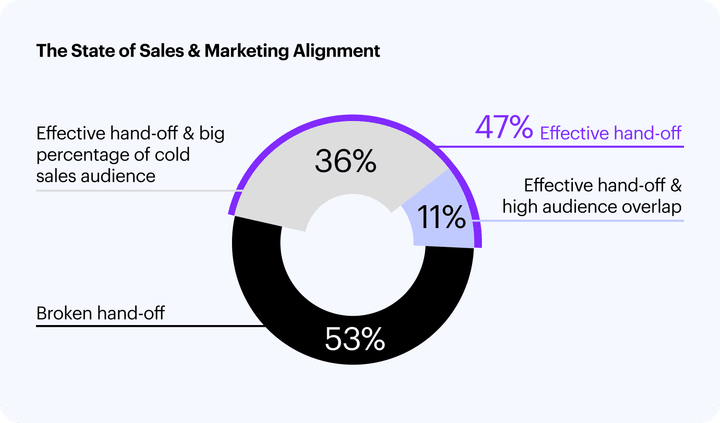
As the graph shows, 53% of companies struggle with a broken hand-off, where sales follow up on fewer than 35% of prospects engaged by marketing.
In contrast, the other 47% of companies have an effective hand-off, with sales teams using marketing engagement signals to decide who to contact and when.
Key takeaways: Alignment that exists only in meetings creates motion, not momentum. Real alignment starts when execution paths and ownership are designed to operate as one revenue system.
How metric mismatch quietly erodes revenue
Phantom alignment hardens when teams operate on different definitions of success. Marketing, sales, and revenue leadership may agree on targets, yet each function measures progress through a different lens.
The result is motion without coordination and optimization without impact.
Marketing is often evaluated on volume, engagement, and campaign performance. Sales is measured on pipeline quality, deal velocity, and close rates. These metrics make sense in isolation, but together they create conflicting incentives.
Marketing pushes to hit volume targets. Sales filters aggressively to protect conversion efficiency. The friction shows up at the handoff, where alignment matters most.
And data becomes a friction point as well. Amidst the AI talk, most organizations’ CRM data is not ready enough for AI agents. Salesforce research shows that 65% of sales professionals do not fully trust their company’s data.
The primary reasons include:
- Incomplete data (38%)
- Data spread across multiple formats (37%)
- Data that isn’t updated regularly (37%)
This misalignment turns AI initiatives and revenue growth into uphill battles rather than force multipliers.
Also, metric mismatch introduces revenue leakage in subtle but repeatable ways:
- Leads qualify in marketing but fail sales acceptance criteria
- Pipeline looks healthy while deal quality deteriorates
- Attribution credits activity without reflecting revenue contribution
- Forecasts swing because upstream signals lack consistency
What’s missing is a shared view of how metrics connect across the funnel and how early-stage decisions influence downstream revenue outcomes.
Over time, teams adapt their behavior to their own scorecards, and revenue performance suffers even as individual functions appear to succeed. This presents a strong reason why marketing & sales teams must coordinate outreach.
Key takeaways: Metric alignment shapes behavior more than strategy decks ever will. Revenue stabilizes only when teams share definitions, incentives, and success criteria across the full GTM system.
Why revenue leakage stays invisible until it’s too late
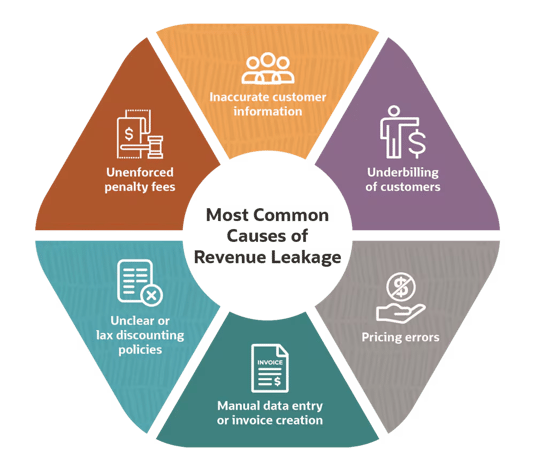
Revenue leakage is the silent killer, until RevOps calls it out. It accumulates through small delays, weak signals, and unowned decisions that compound as deals move forward.
45% of executives view revenue leakage as a systemic issue. To address this, companies can update outdated processes, minimize reliance on inaccurate data, and invest in more advanced software and technology that bridges interdepartmental gaps. These measures can boost profits by up to 5%, according to BCG.
Source: Oracle NetSuite
All the factors responsible lead to the core issue - decision latency. Unfortunately, most GTM systems surface information far slower than the business moves.
Signals about lead quality, handoff friction, or pipeline integrity arrive after teams have already made downstream commitments. Alignment appears intact because outcomes haven’t broken “just yet.”
This creates a dangerous time gap between cause and effect:
- Early-stage misalignment impacts late-stage revenue
- Handoff quality degrades before conversion rates react
- Pipeline inflation hides weakness until forecast pressure spikes
- Financial impact appears only after options to intervene disappear
Dashboards often focus on what has already happened, rather than identifying issues that are currently occurring. This creates a false sense of stability, allowing problems to go unnoticed.
As a result, teams push harder downstream as sales work harder, marketing increases volume, and finance tightens forecasts. But none of this fixes the real problem, which is usually upstream.
Successful organizations focus on early warning signs. By tracking key decision points and thresholds, they can act quickly before issues become costly.
JPMorgan Chase (JPMC) is leveraging AI to drive substantial improvements in operational efficiency, client services, and revenue growth, significantly reducing the risk of revenue leakage.
AI tools like Coach AI and EVEE have boosted client engagement, driving a 20% increase in sales within wealth management. Additionally, AI-powered fraud detection systems have saved $1.5 billion by preventing losses and optimizing operations.
Key AI-driven benefits include:
- Revenue Growth: AI tools improve client interaction and identify new opportunities, contributing to a 20% sales boost.
- Cost Savings: Automation in fraud prevention and operational tasks has saved $1.5 billion.
- Risk Reduction: AI detects fraud with 98% accuracy, safeguarding against significant losses.
Key takeaways: Revenue loss compounds inside time gaps between signal and action. Alignment becomes real only when teams reduce decision latency and surface system health before outcomes are locked in.
Replacing phantom alignment with revenue-level alignment
The HubSpot State of Marketing Report 2025 revealed that, to marketing leaders, the biggest change over the past year is the increased focus on the customer and their experience with the brand.
In the survey, 96% of marketers shared that personalized experiences have directly boosted sales, underscoring the value of closer collaboration between sales and marketing teams.

Source: HubSpot
Revenue-level alignment changes how teams behave because it changes what the system rewards.
When metrics, attribution, and financial signals are aligned, misalignment becomes clear right away instead of only showing up at the end of the quarter. This allows teams to adjust more quickly because they can see the cost of drift early.
What differentiates revenue-aligned organizations is how they instrument alignment:
- Shared revenue metrics: marketing and sales are accountable to the same revenue outcomes, not adjacent KPIs
- Economic handoffs: lead stages and pipeline transitions carry explicit revenue assumptions and thresholds
- Early financial signals: leakage is detected at the handoff level, not at closed-won or forecast review
- Decision clarity: ownership for fixing breakdowns is explicit, not debated in post-mortems
As these mechanisms take hold, something subtle but powerful happens. Teams stop arguing about attribution and start correcting constraints. Meetings shift from status updates to system tuning, and alignment becomes operational.
💡Learn how AI is transforming marketing attribution in 2025
This is where revenue systems gain resilience. Instead of reacting to missed numbers, organizations learn to detect drift early and correct course while the impact is still recoverable. Alignment evolves from a cultural goal into a structural advantage.
The most interesting part is what comes next. Once revenue-level alignment is in place, teams begin asking different questions about pricing signals, capacity allocation, demand shaping, and investment timing.
This is when alignment stops being the goal and becomes the foundation for smarter growth decisions.
Key takeaways: Phantom alignment fades when teams share financial accountability along with goals. Revenue-level alignment turns collaboration into a system that exposes leakage early and compounds performance over time.
To wind things up, phantom alignment persists because it feels productive while quietly escaping financial scrutiny.
The proven way to overcome it is by redesigning alignment as a revenue system, where early signals surface loss before it compounds.
The next competitive gap will come from how quickly organizations learn to see and act on misalignment while outcomes are still reversible.
What’s coming next is even more consequential: once alignment becomes measurable at the financial level, leaders start asking entirely different questions about growth, investment, and control!
And that’s where the real separation begins.