

 Salesforce
 HubSpot
 Claude
.png?width=58&height=58&name=Frame%202087327944%20(1).png) GA4
GA4
.png?width=58&height=58&name=Frame%202087327944%20(2).png) Marketo
Marketo
.png?width=58&height=58&name=Frame%202087327944%20(3).png) Audit Fox
Audit Fox
 Services


AI is becoming one of the most privileged users in your revenue stack.
After all, it connects signals across systems that were never designed to “talk” this freely.
The upside obviously includes faster decisions, sharper targeting, and more efficient operations. But there’s a shift happening at the same time that needs attention.
The shift is that sensitive operational intelligence is now flowing through workflows that traditional controls weren’t built to govern.
A lot of organizations are still treating AI as merely a productivity layer. In reality, it’s the new data surface that can influence business outcomes.
For RevOps, this changes the mandate as it’s no longer enough to optimize processes and maintain clean data. The function must now ensure that how AI accesses, interprets, and acts on data remains compliant, secure, and aligned with organizational risk tolerance.
When guardrails are unclear, teams either slow adoption out of caution or move forward in ways that create invisible exposure.
The companies that scale AI successfully are designing trust into how AI operates from the start, so innovation doesn’t outpace control.
This presents an important question before us! As AI becomes embedded in daily RevOps workflows, what does responsible, secure usage actually look like in practice?
AI Changes the Risk Model for RevOps
Most of us have experienced a moment where we share our phone location with a friend so they can find us at a crowded event. It’s convenient, but later you realize that you’ve effectively given someone real-time visibility into where you are until you turn it off.
AI works similarly inside RevOps. The moment AI is connected to your CRM, marketing automation, support systems, or data warehouse, it gains visibility into sensitive operational signals. The value is undeniable, but so is the responsibility.
Organizations are experiencing a record-high rise in privacy and security incidents related to artificial intelligence. According to Stanford University’s 2025 AI Index Report, AI-related incidents increased by 56.4% in just one year, with 233 cases reported across 2024.
What makes AI different from traditional tools is how it interacts with data. Instead of following predefined rules, it reads context, synthesizes information, and generates outputs that may combine signals across multiple systems. This changes the risk model from “who has access” to “how data flows.”
Consider a simple RevOps scenario. A team member asks an AI assistant to summarize pipeline risks ahead of a leadership meeting.
To do this, the system may analyze deal notes, customer emails, and internal comments, some of which contain sensitive context. Nothing malicious happened, yet sensitive information moved through a process that may not have been fully governed.
Multiply this across dozens of daily interactions, and you begin to see why traditional controls aren’t always sufficient. AI expands the surface area of operational intelligence in several ways:
- Context aggregation: Models can connect signals across systems that were previously siloed
- Continuous interaction: Every prompt becomes a potential data exchange
- Dynamic outputs: Information may be surfaced in new combinations that weren’t anticipated
- Broad visibility: Insights may reach users who didn’t previously access certain data directly
AI is not inherently risky, but the nature of risk has evolved.
RevOps sits at the center of this shift because it manages the flow of revenue-critical information. Pipeline strategy, customer lifecycle data, pricing logic, and performance metrics all pass through RevOps processes.
As AI becomes embedded, the function naturally becomes a steward of how that intelligence is handled.
Smarter teams treat this issue as part of system design. Once you start viewing AI through this lens, it becomes clear that the real question is how to ensure every interaction meets the same security and governance standards you expect everywhere else.
💡Discover how AI in Marketing Ops unlocks growth potential
Key takeaway: AI shifts risk from system access to data flow and interpretation. RevOps must understand how information moves through AI workflows to ensure compliance and security.
Where AI Introduces Hidden Compliance Gaps
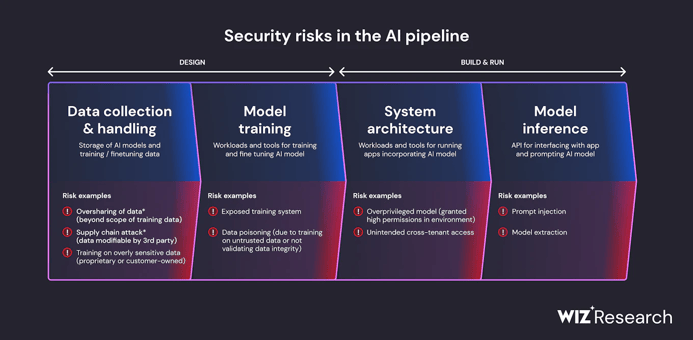
Compliance risks begin with convenience. Think about how often you’ve copied a snippet of text into a tool just to “quickly get a summary.” Even an act as small as moving sensitive information into places no one is actively monitoring can introduce risk.
Source: Wiz
AI creates similar moments across RevOps, where small, well-intentioned interactions gradually expand the surface area of risk. The challenge is the invisible drift that it brings.
Where do these gaps tend to appear?
In practice, AI introduces risk in places that feel more operational than technical in nature.
Shadow AI usage: Teams experiment with AI tools outside approved environments to move faster. A rep uploads account data to generate messaging, and a marketer tests campaign ideas using customer segments. Meanwhile, your RevOps might not even know it’s happening.
Prompt leakage: What goes into prompts matters a lot. This includes detailed customer context, deal strategy, or internal discussions that can expose information beyond intended boundaries, especially when prompts are reused or shared.
Over-permissive integrations: AI connected to multiple systems may inherit broad access. Without careful scoping, it can retrieve more data than necessary to perform a task.
Lack of visibility into model behavior: Many organizations don’t fully understand how models process, store, or learn from interactions, creating uncertainty around data handling.
Real-life analogy: the shared document problem
Think about a shared online document that starts as a small working file. Over time, people add comments, paste sensitive notes, and share with others “just for visibility.” Months later, no one remembers who has access, yet it contains critical information.
AI workflows can evolve the same way. Without clear boundaries, helpful interactions accumulate into exposure.
The governance blind spot
These gaps rarely trigger alerts. While the traditional security controls are designed to detect unauthorized access, it’s difficult for them to keep track of unintended context sharing.
RevOps teams often assume that if systems are secure, workflows are secure. AI breaks that assumption by introducing new pathways where data can move indirectly.
This is why governance must move from controlling systems to understanding interactions.
💡A useful read - The data hygiene crisis: Leadership confidence doesn’t match reality
Why awareness isn’t enough?
Training teams to “be careful” helps, but it doesn’t scale. As AI becomes embedded in daily work, relying solely on user judgment creates inconsistency.
It’s pivotal to recognize that compliance gaps are less about intent and more about design.
And once you start mapping where these hidden gaps exist, this question becomes unavoidable - If risks emerge through everyday workflows, how do you embed guardrails that protect data without slowing the teams using AI?
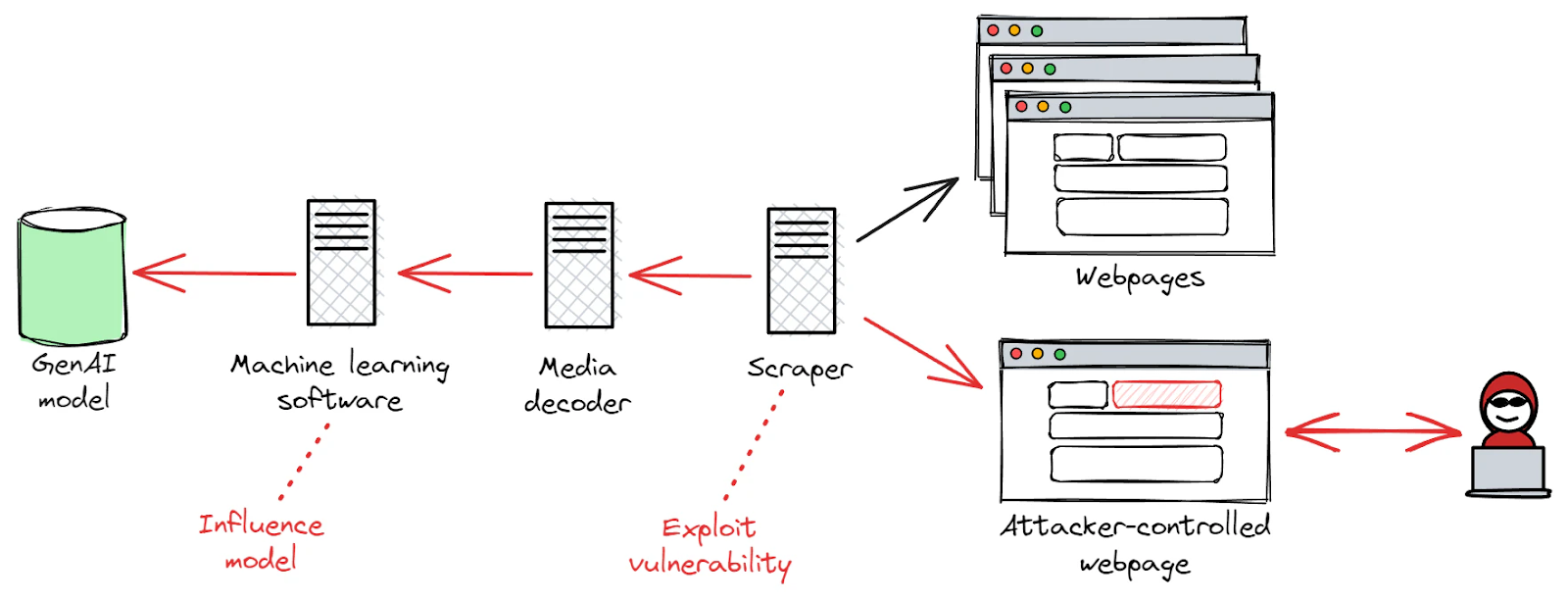
Visualization of an adversary exploiting a data scraper flaw to manipulate a GenAI model during training or fine-tuning. Source: WIZ
Key takeaway: Hidden compliance gaps often arise through routine AI interactions like prompts, integrations, and experimentation. Understanding where these gaps form is essential before designing effective guardrails.
From Policy to Practice: Embedding Guardrails in Daily Workflows
Organizations commonly respond to AI risk by writing policies that people seldom read. The real risk, however, lies in workflows.
If compliance only shows up during audits or annual training, it’s already too late for you. What’s pivotal is that guardrails are designed into how RevOps operates every day
The biggest risk is decision distortion
When people think about AI risk, they imagine leaks or breaches. But one of the least discussed risks is subtler: AI can surface insights that feel authoritative even when context is incomplete.
For example, an AI summary of pipeline health may omit nuance from deal conversations. Teams might adjust strategy based on partial interpretations, not maliciously, but because the system made it easy.
Apart from protecting data, guardrails are about protecting decision integrity.
What does embedding guardrails actually mean?
Instead of treating compliance as a separate function, leading RevOps teams design workflows where safe behavior is the default.
This includes:
- Context-aware access controls: Ensuring AI only accesses the minimum data required for each use case, rather than broad system visibility.
- Prompt boundaries: Clear guidance on what types of information should never be included in AI interactions (e.g., pricing strategy, confidential negotiations).
- Usage monitoring: Observing patterns of interaction to identify risky behavior early without policing teams.
- Explainability checks: Encouraging review of AI outputs in high-impact decisions so context isn’t lost.
These controls don’t block innovation but make experimentation safer.
Think about a shared office fridge. Generally, workplaces don’t post a 50-page policy on how to use it. Instead, there are simple norms: label your food, don’t take what isn’t yours, and clean up after yourself. The environment subtly guides behavior.
AI guardrails should work the same way. Clear expectations and structural cues prevent problems without constant oversight.
The RevOps role evolves
RevOps becomes the orchestrator of safe experimentation. The question becomes “How do we design workflows where teams can use AI confidently?”
This often requires closer collaboration with security and legal, not as gatekeepers but as partners in designing practical controls.
Another insight leaders often overlook
Guardrails increase adoption.
When teams trust that AI usage is safe and well-governed, they experiment more confidently. Without clarity, adoption slows because uncertainty creates hesitation.
How a mature AI governance actually operates
You’ll notice a few signals in organizations that get this right:
- Teams understand where AI is allowed and where it isn’t
- Sensitive workflows have additional review layers
- RevOps dashboards include visibility into AI usage patterns
- Leaders talk about AI governance as part of operational strategy
Compliance becomes part of the operating rhythm rather than an afterthought.
And once guardrails are embedded, the conversation goes from managing risk to scaling trust.
The question to tackle now is, how do you design an operating model where innovation and compliance reinforce each other instead of competing?
Key takeaway: Embedding guardrails into workflows ensures AI is used responsibly without slowing teams down. Well-designed controls protect both data integrity and decision quality.
💡Learn how to use AI to build scalable HubSpot workflows
How RevOps Scales Innovation Without Compromising Trust
By the time organizations reach this stage, the question shifts from whether to use AI to how to use it in a way that strengthens confidence both internally and externally.
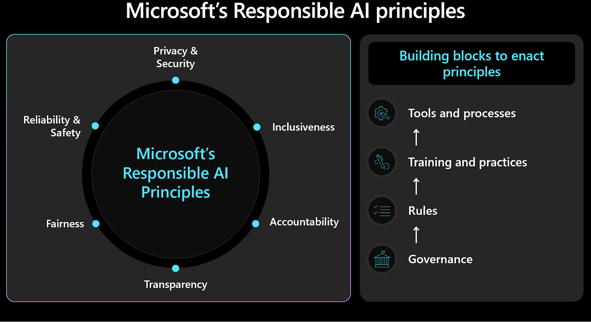
Responsible AI in RevOps is more than a checklist. It’s an operating model that balances three forces: speed, insight, and control. When designed well, compliance supports innovation by removing uncertainty.
Source: Microsoft
Guardrails over gatekeeping
Traditional governance often acts as a barrier. In AI-led environments, this approach quickly becomes a bottleneck.
Guardrails work differently. They define boundaries within which teams can move freely. Instead of asking for permission every time, teams operate within clearly defined safe zones.
For example:
- Sensitive data categories are automatically masked or restricted
- Approved AI environments are clearly defined
- Usage patterns are monitored without interrupting workflows
This creates freedom with accountability.
Data lineage as a confidence layer
One of the most powerful and underappreciated concepts in AI governance is data lineage. It’s about understanding where data comes from, how it’s used, and where it flows.
When RevOps can trace how AI interacts with customer and revenue data, leaders gain confidence that insights are grounded and compliant. Transparency reduces hesitation and supports faster decision-making.
Shared ownership of responsible AI
Responsible AI cannot sit solely with security or IT. RevOps plays a critical role because it understands how workflows actually operate.
A strong model typically includes:
- RevOps defines usage patterns and operational boundaries
- Security, ensuring infrastructure, and monitoring
- Legal guiding compliance, and regulatory considerations
- GTM teams follow clear norms
Think about advanced driver assistance systems. Instead of replacing the driver, they enhance awareness, maintain boundaries, and reduce risk while the driver remains responsible.
AI should function the same way in RevOps by augmenting decisions while operating within defined limits.
Putting it together
Organizations that operationalize responsible AI focus on a few core actions:
- Define where AI is allowed to interact with sensitive data
- Establish clear prompts and usage norms
- Monitor interactions to detect anomalies early
- Build transparency into how insights are generated
Over time, this creates a culture where teams innovate confidently because the system supports safe behavior by design.
The real outcome is the trust that AI can be used to accelerate decisions without introducing hidden risk.
Key takeaway: Responsible AI becomes scalable when governance is embedded into workflows rather than layered on top. RevOps enables innovation by designing systems where speed and security coexist.
The bottom line is, AI will continue to reshape how revenue organizations operate. The advantage will go to those who design for trust from the start.
And as AI becomes more embedded in daily work, one question that will quietly define the leaders is, are your systems merely intelligent, or are they intelligently governed?