

 Salesforce
 HubSpot
 Claude
.png?width=58&height=58&name=Frame%202087327944%20(1).png) GA4
GA4
.png?width=58&height=58&name=Frame%202087327944%20(2).png) Marketo
Marketo
.png?width=58&height=58&name=Frame%202087327944%20(3).png) Audit Fox
Audit Fox
 Services


Kendrick Lamar wasn’t talking about RevOps when he said, “You might as well be dead if you can’t see the end.” But honestly… he might as well have been.
Because that’s exactly where most revenue teams are heading today, blind to what’s coming next.
They’re still running RevOps the old way while the modern market forces are quietly shifting into something very different, AI Ops, where systems predict, adapt, and optimize them in real time.
And that’s revolutionary!
AI Ops is the next layer, or simply the evolution of operational support to intelligence infrastructure.
⦁ Instead of manually segmenting leads, AI builds micro-cohorts from thousands of behavioral signals.
⦁ Instead of teams reconciling errors, systems self-heal broken workflows.
⦁ Instead of leaders reviewing dashboards, AI generates predictions and recommended actions before the problem shows up on a chart.
In an AI-native revenue engine, RevOps stops being the “team that fixes things” and becomes the team that teaches the system how to think.
Early birds indeed catch the worm, and so will the companies that move early will pull ahead with faster iteration, sharper targeting, cleaner data, lower CAC, and an efficiency level human-only GTM teams simply can’t reach.
The question is whether you want to be the company that adapts to it, or be the one that holds back and gets outpaced by those who have already done so?
Why RevOps can’t scale without AI anymore
RevOps was designed to unify revenue teams. However, it wasn’t designed for the volume, velocity, and variability of modern GTM motion.
You witness too many signals, channels, tools, and too much data, and yet, never enough humans to make sense of it all.
That’s the breaking point where RevOps ends… and AI Ops begins.
And admit it, today, the GTM environment moves faster than any operations team possibly can.
Workflows for lead routing, enrichment, forecasting, scoring, reporting, QA, segmentation, and handoffs are still built on human rules, human bandwidth, and human guesswork. Reality is, once you learn how to use AI to build scalable workflows, life becomes exponentially easier.
And as the system grows, those rules break, exceptions pile up, and accuracy plummets.
AI Ops reverses it by absorbing operational load, detecting issues before teams feel the pain, and automating decisions that previously needed judgment, not just logic.
AI reduces the time between signal, decision, and action to nearly zero. And in RevOps, that delay is where most of the revenue friction hides.
This is how the cracks show up today:
- Human-run processes don’t scale; every new channel adds more manual QA, rules, and operations overhead
- Data moves, but intelligence doesn’t; syncs work, but insights don’t
- Teams react instead of anticipating; forecasting relies on snapshot reporting (not behavioral probability).
- Ops becomes the bottleneck; not because Ops is inefficient, but because GTM complexity is exponential
And then something interesting happens once AI enters the system:
- Routing accuracy jumps
- Forecasts stabilize
- Personalization becomes instant
- Errors disappear
- Pilots get launched weekly instead of quarterly
- Revenue teams stop fighting spreadsheets and start making decisions
The difference lies in autonomy.
AI Ops is the layer that allows RevOps to finally scale beyond human capacity, without breaking alignment or accuracy.
💡Discover how to use AI in marketing to bring your business’s mission to reality
Key takeaways:
- RevOps hits a ceiling when humans are responsible for every workflow, rule, and decision. AI Ops removes that ceiling by turning processes into systems that learn and adapt.
- Those who adopt AI Ops early will operate with a level of speed and intelligence that late adopters can’t compete with.
What exactly is AI Ops? (And why it’s not “Just RevOps + Tools”)
Most teams hear AI Ops and assume it’s just RevOps with a fancy new tech stack. That’s far from the truth.
RevOps builds the system, and AI Ops teaches the system how to learn, adapt, and self-correct.
AI Ops is the operational evolution where revenue systems stop waiting for human input and start making informed decisions on their own. It’s the shift from “automating tasks” to “automating judgment.”
And for modern GTM teams drowning in data and operational debt, this shift is exactly what cracks open scale.
These make AI Ops fundamentally different and far more powerful:
- It interprets signals, not just executes steps. Instead of “if lead score > X, then assign,” AI Ops evaluates patterns, probability, and intent. Routing becomes smarter the longer it runs.
- It learns from outcomes, not rules. Traditional automation breaks when edge cases appear. AI Ops improves because of them.
- It connects GTM + Ops + analytics into a single brain. AI Ops unifies the intelligence layer across CRM, marketing automation, sales tools, CS platforms, product data, and finance systems.
- It predicts bottlenecks before humans notice. Failed workflows, missing fields, deteriorating lead quality, abnormal usage patterns, and AI Ops raises the flag before the pipeline slows.
💡Here’s how to leverage Pardot's predictive analytics for improved conversions
Early AI-enabled RevOps pilots showed that AI not only optimized current workflows but also surfaced processes that never should have been there in the first place.
This core difference is that RevOps improves current operations, while AI Ops redesigns the entire operating model by learning what works, eliminating what doesn’t, and scaling what wins, automatically.
Key takeaways:
- AI Ops is a foundational shift where intelligence becomes the operating system for revenue.
- Teams that adopt AI Ops early will run leaner, faster, and more accurately than teams still relying on rules-based automation.
The 5 forces driving the shift from RevOps to AI Ops
The shift from RevOps to AI Ops is happening because the operational environment has broken past the limits of human capacity.
Modern GTM teams operate inside a system far too complex for manual processes, static dashboards, and rules-based automation. Data moves faster, buyers behave unpredictably, tech stacks balloon, and revenue teams are expected to do more with less.
AI Ops emerges as the only model that can keep up with this pace.
Here are the five forces pushing every RevOps team toward AI-native operations:
Data velocity outpaced human processing
Your GTM engine now generates millions of micro-signals daily, intent data, product usage, attribution paths, email engagement, CRM updates, and enrichment changes in the background.
Humans can’t interpret that in real time, but AI can.
- AI detects patterns humans miss.
- AI updates scoring and routing dynamically.
- AI flags anomalies instantly, long before a dashboard refresh.
This is about having data that finally becomes actionable.
Operational debt hit an unmanageable breaking point
Every handoff, every spreadsheet, every manual workflow adds friction, and RevOps can only patch so fast. And let’s be real, the critical RevOps ROI metric you’re not tracking is time.
AI Ops, on the other hand:
- identifies broken processes before they break things
- auto-corrects based on past resolutions
- reduces the bulk of operational rework by learning from patterns
Automation isn’t enough anymore
Rules-based automation helped teams scale from 2 people to 20. But it will not scale from 20 to 200.
Because static rules break:
- when exceptions appear
- when markets shift
- when buyer behaviour changes
- when GTM motions evolve
AI Ops works because things change, not despite it.
💡Here are the 10 tips to develop a successful marketing automation strategy
GTM cycles are shorter, and competitors are faster
The modern buyer moves quickly, channels shift instantly, and relevance deteriorates overnight.
AI Ops gives a competitive edge by:
- predicting what actions will convert
- accelerating testing cycles
- identifying winning motions before competitors catch up
- updating targeting logic in real time
Speed is survival, and there should be no sugar coatings!
💡Discover how AI in Marketing Ops unlocks growth potential.
Leadership now demands predictive answers
A question like this is becoming the norm: “What will break next quarter, and what can we fix now?”
AI Ops provides that visibility by:
- Forecasting pipeline health
- Identifying deal-risk before reps flag it
- Predicting churn using usage and intent patterns
- Generating real-time scenario models for growth
For the first time, there’s an operational shift from reporting the past to engineering the future.
Key takeaways:
- The move from RevOps to AI Ops is structural. Market speed, data complexity, and operational debt have made human-only operations obsolete.
- Teams that embrace AI Ops gain an early advantage: faster iteration, fewer failures, and predictive clarity that competitors can’t match.
The AI Ops growth curve: Where you are vs. Where do you need to be
Many teams expect AI Ops outcomes without appreciating the maturity required to achieve them. AI Ops evolves in stages, with systems gaining intelligence incrementally and RevOps capturing more leverage at every step.
There are four levels. Every GTM team sits on one of them, whether they know it or not.
Reactive
At this level, you only act when something breaks, and this is where most teams still operate today. Everything depends on humans noticing issues and responding manually.
Common signs:
- Reports are updated only when someone asks
- Errors discovered by sales or CS, not Ops
- Routing inconsistencies
- Forecasts based on rep sentiment
- Ops are always in triage mode
Automated
Now the workflows run, but the intelligence doesn’t. Basically, this is the classic RevOps automation stack where tasks are automated, but judgment is still human.

You see:
- Rule-based scoring
- Static routing assignments
- Dashboards are refreshed on a schedule
- QA done manually
- Fixes applied case by case
Hence, automation helps, but scale exposes its limits quickly.
Predictive
At this stage, systems sense problems before humans do. So this is where AI Ops truly begins.
The system interprets signals, anticipates risks, and warns teams before issues surface.
You get:
- Forecast stability
- Deal risk alerts
- Early churn indicators
- Dynamic scoring and routing
- Detection of data drift and anomalies
At this juncture, RevOps moves from maintaining processes to supervising intelligence.
Autonomous
Now the system optimizes itself! This is the final stage, and the revenue engine learns continuously and adjusts without waiting for a human decision.
You start seeing:
- Workflows that self-correct
- Models that tune based on outcomes
- Targeting logic updated in real time
- Multichannel GTM plays are generated from patterns
- Pilots launched automatically based on winning signals
Your GTM engine evolves as fast as the market does.
Why the future belongs to AI-native RevOps teams
A significant misconception is that AI Ops is merely a technology upgrade. It is, rather, an operating shift.
For instance, GenAI is rapidly transforming work by using powerful generative models to turn data into new text, images, audio, and video, enabling faster innovation and greater efficiency.
Its adoption has accelerated, with organizations across industries embracing GenAI. Gartner forecasts that by 2026, 80% of enterprises will be using GenAI applications.
GenAI can unlock significant sales potential by enabling average performers to operate more like top sellers and freeing up more time for customer engagement. In doing so, it helps organizations “move the middle,” boosting overall sales productivity and performance.
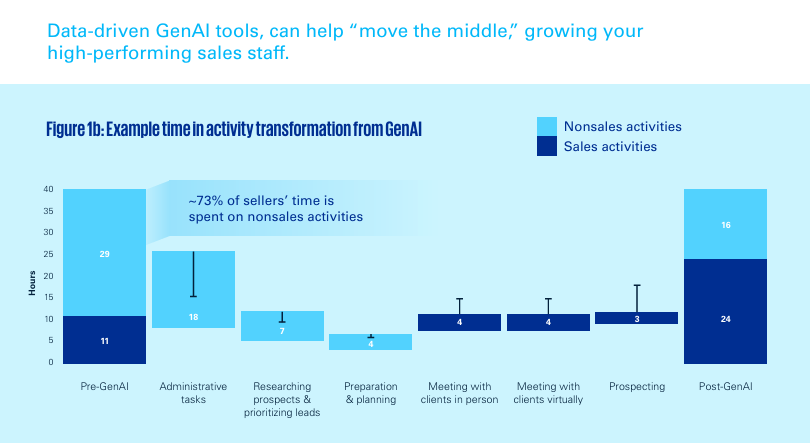
Source: KPMG
It’s not hard to notice that the AI-native teams treat their revenue engine like a living system. They expect it to evolve and change its own behavior. They also expect it to discover insights that no human would ever notice. And then they build RevOps around that expectation.

This is the real competitive advantage.
Most GTM teams still run on static logic, where they ship a workflow once and keep patching it until it collapses. They launch a routing model, forget to update it, and wonder why conversion drops. They run on the assumption that a dashboard tells them the truth, even if the underlying patterns have shifted months ago.
AI-native teams reject these assumptions entirely.
They build GTM engines that:
- Learn from every closed-won and every closed-lost
- Rewrite their own playbooks based on outcomes
- Update ICP definitions as behavior changes
- Tune scoring models based on buying patterns
- Surface market shifts before humans feel them
How to move up the curve?
You climb the maturity curve by improving the intelligence layer. AI needs clean, enriched data to learn the right patterns, and it needs clear boundaries so agents know where to act and where to escalate.
Strong feedback loops accelerate growth. When RevOps reviews outcomes and corrects errors, the system gets smarter with every cycle.
Model governance keeps predictions stable and aligned with changing GTM conditions. Continuous experimentation provides fresh data that sharpens the engine even further.
The final unlock is having RevOps teams trained to supervise machine learning outcomes.
This is how the system evolves with control instead of chaos.
AI compounds when it learns continuously. Starting early gives you an advantage that widens with every cycle.
The bottom line is, the next era of RevOps belongs to teams that treat intelligence as the core system, not a feature. AI-native operations will out-iterate, out-adapt, and outpace every static GTM engine still relying on human bandwidth.
Teams that delay this shift will continue to fight against their own entropy. Tools expand, processes decay, and operational debt grows by the month.
The gap between AI-native and non-AI-native operations will not be linear. It will widen exponentially because one side compounds insight while the other compounds friction.
The decision is simple but irreversible. So build a GTM engine that learns, or compete against teams that already have.