

 Salesforce
 HubSpot
 Claude
.png?width=58&height=58&name=Frame%202087327944%20(1).png) GA4
GA4
.png?width=58&height=58&name=Frame%202087327944%20(2).png) Marketo
Marketo
.png?width=58&height=58&name=Frame%202087327944%20(3).png) Audit Fox
Audit Fox
 Services


Enterprises have never had more software, but can you say it has helped them move faster than before?
In fact, what started as a push for best-in-class tools turned into a drag on execution. Your teams jump between systems, search for context, juggle conflicting data, and rebuild the same views again and again.
This is the tech stack gluttony paradox, where every new tool promises efficiency. Still, each addition adds another layer of navigation, another interface to learn, and another place where truth can drift. To make matters worse, over time, the stack stops amplifying productivity and starts taxing it.
The real cost is attention because when employees spend way too much time locating information rather than acting on it, speed disappears, decisions slow down, and accountability blurs. Execution suffers even when the right tools are technically in place.
What’s emerging now is a shift in how leading organizations think about their stacks. The conversation is moving away from how many tools they use and toward how coherently those tools work together.
And that shift raises an important question: when software becomes the bottleneck, what actually needs to change?
When more software made teams slower, not smarter
Admit it, for years, adding tools felt like progress. Each new platform promises something new, and in isolation, most of those decisions made sense.
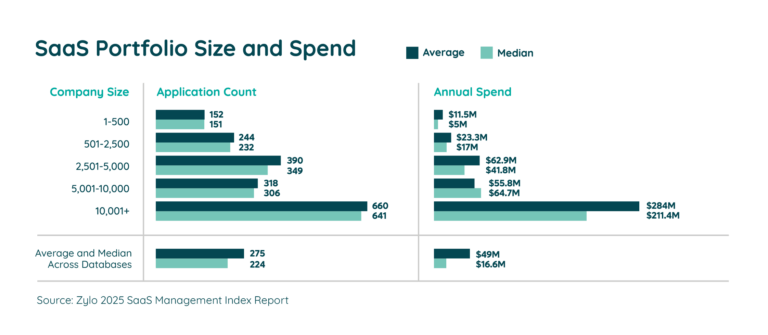
However, collectively, they created a system that now works against itself. According to Zylo’s 2025 SaaS Management Index, organizations manage an average of 275 applications, with poor utilisation contributing to roughly $49M in annual spend. That inefficiency represents both wasted budget and untapped value.
The slowdown came from accumulation. As stacks expanded, execution capacity failed to keep pace. Teams now spend a growing share of their time navigating tools instead of moving work forward.
This friction shows up in longer cycles, duplicated effort, and repeated correction cycles just to answer basic questions.
What makes this hard to diagnose is that the capability keeps increasing while the effectiveness declines. Leaders see activity across integrations, automations, and dashboards, but teams feel drag.
Several patterns signal that the stack has crossed from enablement into obstruction:
- Workflows require hopping across multiple tools to complete a single task
- Teams rebuild the same analysis because no system feels authoritative
- Decisions stall while people search for context instead of acting
- Ownership blurs because execution spans too many platforms
At this point, the issue is structural. The stack was designed to add capabilities, not to preserve speed. Without intentional design, every new tool increases cognitive load and erodes momentum.
This is why simply “using the tools better” rarely fixes the problem. The system itself has outgrown the way work actually happens.
💡Learn how to onboard, implement, and manage a new tool in your tech stack
Key takeaway: Software stops being an advantage when accumulation outpaces execution design. Speed returns only when stacks are built around how your work flows, not how tools are bought.

Why didn’t integration solve the problem it was meant to fix
When tool sprawl became obvious, integration was positioned as the fix. If you connect the systems and sync the data, the stack would behave like a single platform. In practice, integration solved connectivity while leaving the deeper problem untouched.
The harsh reality is that most integrations move data, not meaning. Despite countless field syncs and record updates, teams still argue over which system is the “right one.”
The stack becomes technically connected but operationally fragmented. Data flows, but decisions remain stagnant when they need to evolve.
This creates a subtle illusion of progress. Leaders see pipelines moving between systems and assume clarity has improved. On the ground, teams still translate, validate, and sort out stuff before acting. So, while integration reduced manual entry, it didn’t reduce cognitive load.
💡Discover the common HubSpot-Salesforce integration challenges & the best practices to overcome them.
Consider a common scenario: A revenue leader asks a simple question: Which deals are at risk this quarter?
- Marketing points to engagement signals in the automation platform.
- Sales references CRM stage movement.
- Customer success flags product usage trends.
All three data sources are integrated, yet none provide a clear, shared answer. As a result, RevOps spends days stitching context together while the window to intervene shrinks.
The underlying issue is that integrations were built around data transfer, not decision flow. They answer where data lives, not how work should move. As a result, integration layers grow thicker while execution speed stays flat.
This is why “just add another integration” so often backfires. Each connection introduces hidden assumptions about timing, ownership, and meaning. Eventually, the stack is tightly wired but barely understood by anyone.
The real unlock comes when teams begin figuring out how decisions travel through the stack.
Key takeaway: Integration improves connectivity, not clarity. Execution speed improves only when stacks are designed around decision flow, not just data sync.
The hidden cost of shelfware and search-driven work
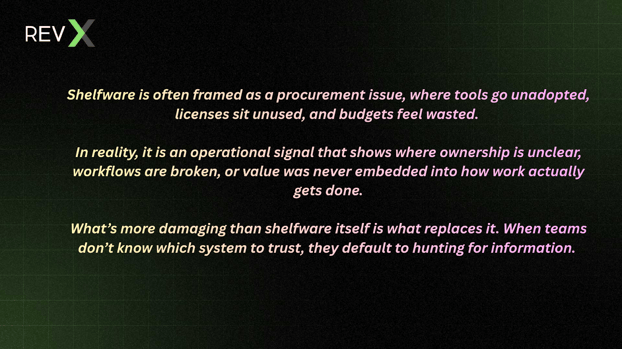
Soon, the tabs multiply, Slack questions replace workflows, and decisions get delayed while people look for context instead of acting on it.
This creates a silent productivity drain that compounds daily.
Consider a typical RevOps scenario: A sales manager wants to understand why a segment is underperforming. After all, data exists across the CRM, marketing automation, enablement tools, and a BI dashboard.
But none of them alone tells the full story. So, the manager asks RevOps, which pulls reports, cross-checks fields, validates timestamps, and juggles discrepancies. By the time an answer emerges, the week is over, and the insight is already stale.
This pattern repeats across teams where marketing searches for attribution clarity, sales searches for account context, and leaders search for confidence before committing to decisions. Basically, the stack is overflowing, yet confidence remains elusive.
The deeper issue is cognitive load. Every additional tool introduces another mental model employees must maintain. As stacks grow, so does the effort required just to stay oriented. As a result, energy shifts from problem-solving to navigation, from strategy to survival.
This is why shelfware persists even after consolidation. Removing tools doesn’t restore clarity if the remaining systems still force people to search instead of deciding.
Key takeaway: Shelfware and search-driven work are symptoms of a deeper design flaw. When stacks don’t clearly guide decisions, teams compensate by searching. Thus, speed, confidence, and momentum quietly erode.
From consolidation to coherence: redesigning the modern stack
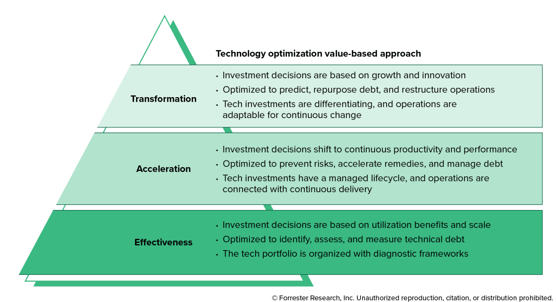
Source: Forrester
By the time organizations reach stack saturation, consolidation feels inevitable. Your tools get cut, budgets get reviewed, and vendors get rationalized. But consolidation alone rarely restores speed. It simply reduces noise without fixing the underlying problem.
What leading teams are doing differently is aiming for coherence, not minimalism.
Coherence means designing the stack around how work and decisions actually flow.
- You can have many systems and still operate smoothly if everyone knows where to go for what, how data flows, and which source is the truth.
- You can also have very few systems and still be a mess if people are confused, duplicating work, or arguing over numbers.
Your goal should be to ensure every remaining system has a clearer role in moving work forward.
This requires a shift in how the stack is designed:
- Decision-first architecture: systems are evaluated based on which decisions they support, not just the features they offer
- Clear ownership boundaries: every tool has a defined purpose and a single source of truth
- Guided workflows over free exploration: systems direct users toward action instead of forcing them to search for context
- RevOps as the steward of coherence: stack design becomes an operational discipline, not an IT exercise
According to Forbes, nearly 75% of companies are expected to adopt technologies like big data analytics, cloud computing, e-commerce, digital trade, and AI between 2023 and 2027.
Over 86% also plan to embrace digital platforms and apps within this same timeframe. This underscores the critical need for businesses to stay ahead of emerging technologies and proactively explore how they can be integrated.
At the very least, businesses should evaluate their tech stack annually, identifying potential upgrades, shifts, or new integrations to stay competitive. And if you discover a superior solution, don’t hesitate to disrupt the status quo internally.
Moving on, consider a practical scenario: A company reduces its stack from 18 tools to 10. On paper, complexity drops, but in practice, teams still bounce between systems because the remaining tools weren’t redesigned to align with the decision flow. Reporting improves slightly, but execution speed remains the same.
Contrast that with a coherence-led redesign, where the company maps its core revenue decisions, encompassing lead prioritisation, deal risk, and forecast confidence, and designs the stack to surface answers automatically.

As a result, its systems are configured to guide action, not just display data. Thus, fewer questions require meetings, fewer decisions require discussions, and work accelerates without adding pressure.
And now, RevOps plays a defining role by becoming the function responsible for translating strategy into system behaviour. After all, it’s not merely about choosing tools, but shaping how they work together to reduce friction and restore momentum.
Coherence turns the stack from a collection of capabilities into an operating system.
Key takeaway: Consolidation cuts cost, but coherence restores speed. The modern stack delivers value only once it goes beyond features and is designed around decisions, ownership, and flow.
The bottom line is, tech stack gluttony failed because systems were added faster than the decision flow was designed.
Your next competitive advantage will come from building stacks that think, guide, and resolve ambiguity on their own, and that raises a deeper question about what kind of operating system your organisation is really running.
So what tech stack is running your company when no one is watching?



-1.webp?width=352&name=New%20Tool%20In%20Your%20Tech%20Stack%20-%20Blog%20Image%20(1)-1.webp)