
 Salesforce
 HubSpot
 Claude
.png?width=58&height=58&name=Frame%202087327944%20(1).png) GA4
GA4
.png?width=58&height=58&name=Frame%202087327944%20(2).png) Marketo
Marketo
.png?width=58&height=58&name=Frame%202087327944%20(3).png) Audit Fox
Audit Fox
 Services


We often see companies try to make revenue more predictable by improving pipeline visibility and tightening forecasts. But unpredictability comes into the picture after a customer signs.
A deal may close on schedule, but if onboarding drags or product adoption fumbles, the future revenue tied to that customer becomes uncertain. In the long run, this friction accumulates.
The issue is that revenue metrics and customer experience metrics live in separate worlds. Your departments rarely combine these signals into a single view of how revenue actually behaves over time.
Truth is, when onboarding rate, time-to-value, and product adoption are treated as operational inputs rather than downstream observations, a clearer picture emerges. And you can see whether growth is durable or fragile long before financial outcomes reveal it.
This shift reframes predictability itself. How? Instead of asking how to forecast revenue more accurately, the question becomes how to design an experience that makes revenue inherently more predictable.
And once you start looking at performance through that combined lens, it becomes clear that many of the signals shaping future revenue are not yet connected.
Revenue Predictability Is an Experience Problem First
Your onboarding rate acts as a leading indicator of revenue health. Consistent onboarding creates momentum, helping customers reach value faster and increasing confidence in renewals. Variability, on the other hand, introduces uncertainty that eventually shows up in forecast volatility.
Product adoption metrics only deepen the picture. Engagement depth, feature usage, and time-to-first-value often reveal whether revenue will compound or plateau.
These signals influence lifetime value long before financial metrics move, yet they’re rarely treated with the same importance as pipeline indicators.
Across high-performing organizations, a clear pattern emerges:
- Stable onboarding correlates with predictable renewals
- Strong adoption increases expansion likelihood
- Early friction reduces future revenue durability
The issue is how the data is interpreted. Revenue teams optimize for closing, while customer teams optimize for experience, leaving a gap where leading indicators of revenue health go underutilized.
When revenue and customer experience are viewed through a single lens, leaders gain earlier visibility into whether growth is sustainable. Small shifts in onboarding or adoption can explain changes in forecast confidence well before revenue numbers move.
Seeing this connection changes how teams think about predictability, and raises a critical question: If experience signals shape revenue outcomes so directly, what would forecasting look like if they were treated as core inputs rather than after-the-fact diagnostics?
💡Learn how to use demand forecasting to boost the bottom line
Key takeaway: Revenue predictability improves when onboarding and adoption are treated as leading indicators of performance. Experience stability provides earlier insight into revenue risk than pipeline metrics alone.
The Metrics That Actually Connect Experience to Revenue
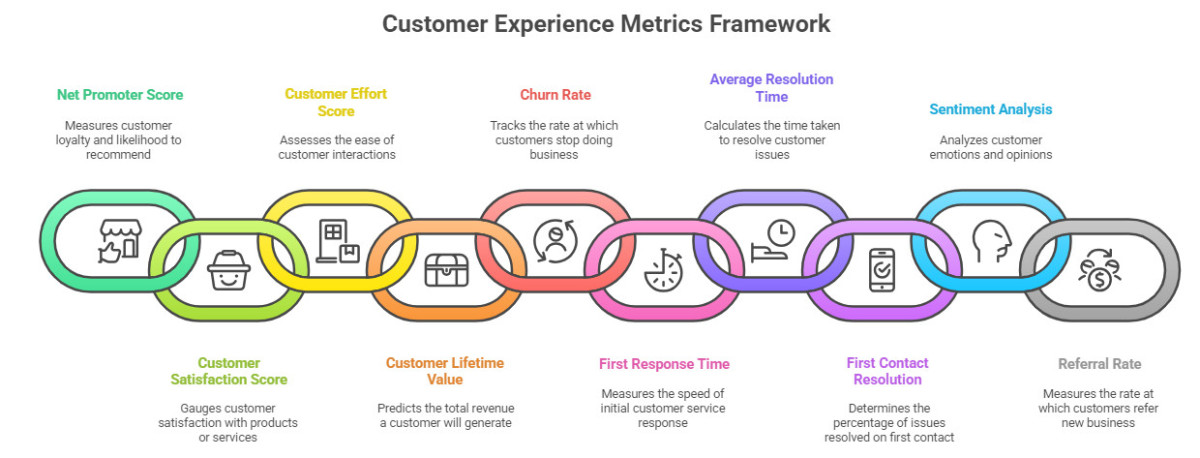
Source: YourCX
84% of companies that invest in improving customer experience report revenue growth.
While organizations track customer experience, they often undermine the signals that connect the two in a way that actually influences decisions.
Ask a revenue leader how the quarter looks, and likely, you’ll hear about pipeline coverage or win rates. Likewise, when you ask a customer success leader, you’ll hear about NPS or support tickets.
But it doesn’t shed light on whether customers are actually moving toward long-term value.
The metrics that matter live closer to behavior, and they tend to show up way before financial results do.
For instance, consider the onboarding rate. In one company, RevOps noticed something odd where deals were closing at a healthy pace, but renewals felt increasingly “negotiated.”
A closer look showed that onboarding completion had moved from three weeks to six. As a result, customers were reaching value slower than expected.
Then, as soon as onboarding velocity became a shared KPI, renewal predictability improved without changing pricing or sales strategy.
Product adoption tells similar stories. Think about how streaming platforms track whether users actually watch content after signing up. A subscription isn’t valuable unless usage follows. The same applies to software.
A customer who logs in daily and uses core features behaves very differently from one who signs the contract and disappears into “we’ll roll this out later.”
💡Lead qualification: How to identify who your potential customers are?
Let’s say an enterprise company found that accounts using three or more key features within the first 60 days renewed at nearly double the rate of low-usage accounts. That insight shifted conversations from “Did we close the deal?” to “Did the customer actually start succeeding?”
Then there’s time-to-first-value, the moment when a customer experiences something tangible enough to justify their decision. Shortening this timeline often has a bigger impact on revenue durability than improving late-stage conversion.
The harsh reality is that customers churn because they never fully experience the benefit.
And yes, there’s a lighter side to this reality. Every revenue team has heard some version of:
“We signed them, but they’re still ‘getting internal alignment.’”
Translation: onboarding hasn’t really started, and future revenue just became a guessing game.
Effective organizations treat these metrics as shared operational signals, not as departmental scorecards. Instead of living only in customer success dashboards, they inform forecasting discussions, pipeline reviews, and growth planning.
Key metrics that bridge experience and revenue include:
- Onboarding rate: how quickly customers reach operational readiness
- Time-to-first-value: how fast customers experience meaningful outcomes
- Product adoption depth: breadth and frequency of feature usage
- Early engagement patterns: indicators of expansion or churn risk
Once you start watching how customers actually behave after the sale, you begin to see patterns that pipeline alone can’t reveal. These patterns raise an important question: if these signals exist, why do so many organizations still struggle to act on them in time?
Key takeaway: Onboarding velocity, adoption depth, and time-to-value provide early signals of revenue durability. When these metrics inform planning, teams can anticipate changes instead of reacting to them.
💡Learn why customer-centric marketing is important
The Unified Performance Model: Designing Revenue Around Experience
You try to connect revenue and customer experience by adding more reports to the mix. Yes, it helps with visibility, but it rarely changes how decisions are made.
Start with a shared lens, not separate scorecards
In a unified model, onboarding rate, product adoption, and expansion signals sit alongside pipeline metrics in the same conversation. Instead of asking “How many deals will close?” you ask, “How healthy is the revenue we’ve already created, and what does that mean for what comes next?”
This takes the focus from short-term volume to long-term durability.
For example, if onboarding velocity slows, the model adjusts expectations around renewals and expansion early. If adoption accelerates in a segment, it signals where to double down before growth shows up in bookings.
Revenue becomes less reactive because it’s grounded in real customer behavior.
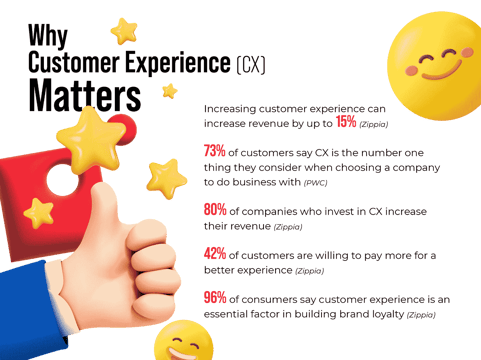
Source: Impact
What does this look like in practice?
High-performing organizations build operating rhythms where revenue and experience signals continuously inform each other.
They integrate:
- Onboarding rate into forecasting assumptions: Slow onboarding becomes a trigger for proactive engagement, not a retrospective insight.
- Product adoption into pipeline strategy: Segments with strong usage patterns influence targeting and expansion planning.
- Customer health into revenue review: Quarterly reviews examine behavioral trends alongside bookings, not after them.
- Time-to-value into growth planning: Improving early customer outcomes becomes a lever for predictable expansion.
This approach reduces surprises because signals are interpreted in context, not in isolation.
A practical mental model: revenue as a living system
Think of revenue like a garden rather than a factory line. Deals aren’t simply “produced.” They grow over time, influenced by conditions such as onboarding quality, product value, and ongoing engagement.
You wouldn’t judge a garden’s success only by how many seeds you planted. You’d watch soil health, water levels, and growth patterns. Similarly, a unified model monitors the conditions that allow revenue to flourish.
The leadership advantage
When revenue and CX operate through a single performance lens, leaders gain something rare: earlier certainty.
They can:
- Detect revenue risk months before it hits financial reports
- Identify expansion opportunities through usage signals
- Align teams around shared outcomes instead of departmental metrics
- Allocate resources based on where customers are succeeding, not just where deals are closing
And now, they can influence results while they’re still forming.
Why does this change how RevOps operates?
RevOps becomes the integrator of behavioral and financial signals. Rather than reporting on past performance, it designs systems that continuously translate customer experience into actionable revenue insight.
Basically, the role shifts from measuring performance to shaping it.
💡These 5 B2B lead gen trends will help you hit revenue goals.
Key takeaways: A unified performance model treats onboarding, adoption, and customer health as core inputs to revenue planning.
When experience informs decisions continuously, revenue becomes more predictable and resilient.
How to Operationalize Revenue + CX as One Performance Engine
Understanding that revenue and customer experience are connected is useful. Designing your operating model around that connection is where real leverage begins.
The most effective organizations wire these signals directly into how they forecast, prioritize, and intervene. Revenue predictability for them becomes a design outcome by default.
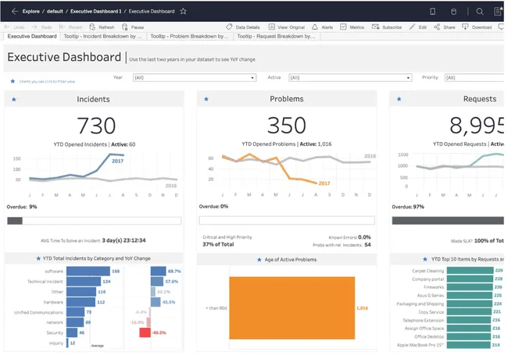
HubSpot Customer Experience Dashboard
Step 1: Define a shared definition of “healthy revenue”
Start by aligning leadership on what good looks like beyond bookings.
Healthy revenue is about the deals that onboard quickly, adopt meaningfully, and show early signs of expansion. A simple framework includes:
- Deals reaching onboarding milestones within a defined timeframe
- Accounts achieving early product adoption benchmarks
- Customers showing engagement patterns linked to renewals
- Expansion readiness is tracked alongside pipeline health
This creates a common language across sales, customer success, and RevOps.
💡Discover how AI in RevOps finally breaks organizational silos
Step 2: Make onboarding and adoption operational triggers
A lot of companies review onboarding and adoption retrospectively. The ones winning are the teams that treat them as real-time signals that trigger action.
For example:
- If onboarding completion slows, RevOps flags forecast assumptions for review
- If adoption dips in a segment, customer success increases proactive engagement
- If time-to-value improves, leadership recalibrates expansion expectations
The goal is simple: signals lead to action before outcomes change.
Step 3: Build one review rhythm instead of many
Instead of separate pipeline reviews, customer health meetings, and renewal discussions, unify the conversation around momentum.
A unified review asks:
- What’s happening in the pipeline?
- How are new customers progressing?
- Are adoption patterns strengthening or weakening future revenue?
- Where should we intervene early?
This reduces fragmentation and ensures insights travel faster across teams.
💡Revenue visibility reinvented: Dashboards vs Decision Intelligence
Step 4: Equip RevOps to connect behavioral and financial signals
RevOps becomes the translator between what customers do and what revenue becomes.
This means:
- Integrating product usage with forecasting models
- Mapping onboarding milestones to revenue timelines
- Surfacing early risk signals in leadership dashboards
- Creating shared KPIs that reflect lifecycle performance

A relatable scenario
Imagine planning a long road trip. You wouldn’t only check how far you’ve traveled, but also watch fuel levels, engine temperature, and road conditions to know whether you’ll reach your destination smoothly.
Running revenue without CX signals is like driving while only watching the odometer. You know where you are, but not whether you’ll arrive comfortably.
When onboarding, adoption, and engagement are visible, leaders can adjust course before problems arise.
The compounding advantage
Organizations that operationalize revenue and CX together experience fewer surprises. Forecast discussions become calmer, and renewal cycles feel more predictable.
Most importantly, teams stop treating customer experience as a downstream responsibility and start seeing it as a core driver of performance.
Key takeaway: Operationalizing revenue + CX requires turning onboarding and adoption into real-time inputs. When signals trigger action early, predictability becomes a built-in capability.
The bottom line is, the most predictable revenue engines are the ones designed around how customers actually succeed.
And once revenue is viewed through that lens, the next question naturally follows,
“What other 'non-financial' signals might be shaping your future performance today?