
 Salesforce
 HubSpot
 Claude
.png?width=58&height=58&name=Frame%202087327944%20(1).png) GA4
GA4
.png?width=58&height=58&name=Frame%202087327944%20(2).png) Marketo
Marketo
.png?width=58&height=58&name=Frame%202087327944%20(3).png) Audit Fox
Audit Fox
 Services


Enablement used to mean training sessions, playbooks, and documentation. That model worked when GTM motions were simple, teams were centralized, and decisions moved at a human pace. Things are understandably different now.
Today, RevOps teams are expected to coordinate sales, marketing, customer success, and partners across dozens of tools and constantly shifting priorities. Now the decision latency has become a bigger bottleneck than execution.
These questions might sound familiar to you:
- Who should focus on which accounts?
- Which partners deserve attention?
- Which signals matter now?
Automation helped remove manual work, but it didn’t solve ambiguity. RevOps still spends enormous effort translating strategy into day-to-day guidance that teams can actually use, and partner ecosystems make that problem exponentially harder.
This is where AI changes the equation by becoming the layer that turns data, context, and intent into real-time guidance at the moment decisions are made.
When AI acts as enablement, it reduces hesitation, aligns actions, and scales judgment across teams and partners without adding overhead.
The question of the hour is, what happens when enablement is no longer confined to documents and becomes the backbone of your system?
Enablement Is Broken at Scale, and RevOps Feels It First
Decision friction
According to McKinsey, ineffective decision-making may cost managers at a typical Fortune 500 company more than 500,000 workdays annually, amounting to about $250 million in wages.
Decision friction is the gap between having information and knowing how to act on it. Dashboards, reports, and playbooks reduce information gaps, but they often increase decision friction.
Ironically, teams have more data than ever, yet less confidence about which action is correct right now.
RevOps encounters this first because it sits between strategy and execution. When enablement fails, RevOps absorbs the questions, the exceptions, and the escalations.
Enablement debt
Enablement debt accumulates when guidance is documented but not operationalized.
As a result, your playbooks go stale, partner guides diverge from reality, and training captures intent at a point in time, while systems evolve underneath.
The more tools and partners you add, the faster this debt compounds. RevOps teams end up manually translating yesterday’s guidance into today’s workflows.
💡Discover the compound effect of tech debt in RevOps
Why partners amplify the problem
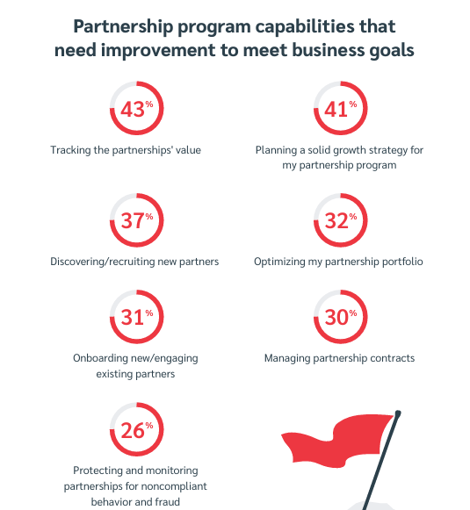
Direct sales teams can rely on tribal knowledge, but partners cannot. They depend entirely on enablement to act correctly.
When guidance is inconsistent, delayed, or fragmented across systems, partner execution becomes uneven and unmanageable at scale.
Source: Impact
This is why partner operations often feel chaotic even when internal GTM motions appear “under control.” Enablement hasn’t scaled with complexity.
The hidden cost
Broken enablement doesn’t just slow execution. Rather, it creates:
- Inconsistent targeting across teams
- Misaligned partner effort
- Reactive RevOps intervention
- Lost trust in central guidance
At that point, enablement becomes noise instead of leverage.
Key takeaway: Traditional enablement fails at scale because it reduces information gaps but increases decision friction. RevOps experiences this first because it’s where strategy and execution collide.
AI as Enablement: From Static Guidance to Real-Time Judgment
It’s not uncommon to misunderstand where AI creates value in RevOps. You expect it to automate tasks faster or generate better insights. Yup, that’s useful, but it misses the bigger shift that AI becomes truly powerful when it reduces decision friction, along with operational effort.
Source: Devs_Data
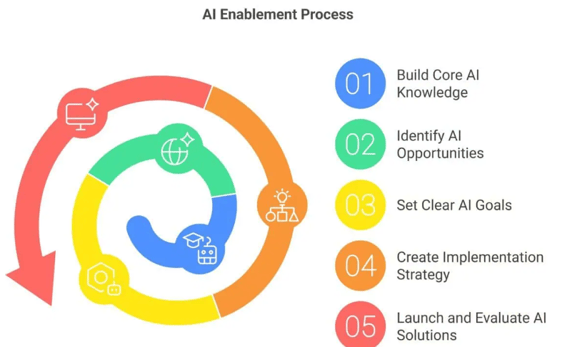
Traditional enablement tells people what should be done. AI-enabled RevOps helps teams decide what should be done next, given the current context.
Enablement as judgment
Instruction assumes stability, and judgment adapts to change. Playbooks work when conditions stay the same, but AI works when they don’t.
AI as an enablement layer continuously evaluates signals across pipeline health, partner performance, account behavior, and historical outcomes. Instead of pushing static rules, it guides choices in real time, based on what’s most likely to work now.
This is the same transition SalesOps went through when automation replaced manual task execution. Automation eliminated hesitation around how work gets done. AI does the same for decision-making.
Enablement at the point of execution
The most valuable guidance is delivered in the moment someone is about to act. AI embeds enablement directly into workflows.
When a seller chooses which account to prioritize, when a partner selects a deal motion, or when RevOps evaluates where to allocate resources, the system provides contextual direction without requiring interpretation or escalation.
Consider how modern navigation apps changed driving. Before them, drivers relied on static maps and memorized routes. When traffic conditions changed, people reacted late or guessed.
Navigation apps didn’t replace drivers. Rather, they enabled better decisions by continuously adjusting routes based on live conditions. Drivers stayed in control, but judgment scaled.
AI plays the same role in RevOps. Instead of asking RevOps which partner to prioritize, which account to target, teams receive guidance shaped by real-time data and historical outcomes. So, while RevOps defines intent and constraints, AI handles adaptation.
💡Here’s something worth exploring - Partnership Marketing Roadmap: From Brainstorm to Outreach
This matters for scale because, as GTM motions and partner ecosystems grow, central teams cannot manually guide every decision. AI allows judgment to exist everywhere without being centralized.
Thus, enablement becomes embedded within the system itself, rather than being something RevOps has to manually deliver.
Key takeaway: AI transforms enablement from static instruction into real-time judgment.
When guidance moves into execution, RevOps scales clarity instead of chasing alignment.
Why Partner Operations Are the Real Stress Test for AI Enablement
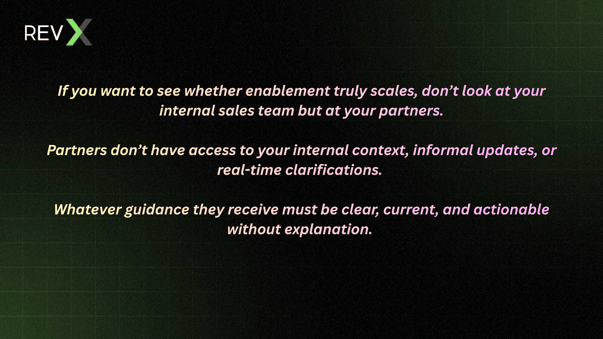
When internal enablement breaks, teams compensate. When it breaks for partners, execution simply fails.
This is why partner operations expose enablement gaps faster than any other GTM motion.
In a lot of organizations, partner enablement still relies on static assets, periodic training, and manual coordination.
AI transforms this model by taking enablement from broadcast to coordination. So, instead of treating all partners the same, AI evaluates context continuously and adapts guidance accordingly. Thus, enablement becomes situational rather than generic.
For example, AI can:
- Differentiate guidance for high-performing partners versus new or inconsistent ones
- Adjust recommendations based on deal size, account maturity, and historical conversion
- Surface the right motions for strategic deals versus opportunistic pipeline
Routing and prioritization are where this shift becomes most visible as static rules age quickly. AI-driven enablement responds to live signals, including:
- Partner win rates and deal velocity
- Responsiveness and follow-through
- Downstream customer success and expansion patterns
Partners are guided toward work they are most likely to win, while RevOps maintains control without micromanaging individual decisions.
Incentives also become more effective when enablement is dynamic. Traditional partner programs lock incentives to assumptions made months earlier. AI enables alignment with what the business needs now by:
- Highlighting which behaviors are driving revenue quality
- Redirecting focus away from low-impact motions
- Reinforcing actions that consistently produce durable outcomes
A critical aspect here is that RevOps gains leverage by defining the guardrails, success criteria, and risk thresholds. Taking those cues, AI applies them consistently, everywhere.
At scale, this eliminates constant exception handling, which is one of the most challenging aspects of partner operations.
As a result, partners act with confidence because guidance is no longer confined to documentation and starts living inside the system. Also, enablement finally scales without requiring central oversight.
💡Here’s an interesting read - How our partnership with Potion can bolster your conversion rate.
Key takeaway: Partner operations reveal whether enablement truly works at scale.
AI makes consistent, contextual guidance possible across partners without increasing RevOps overhead.
How RevOps and Partnerships Build an AI-First Revenue System
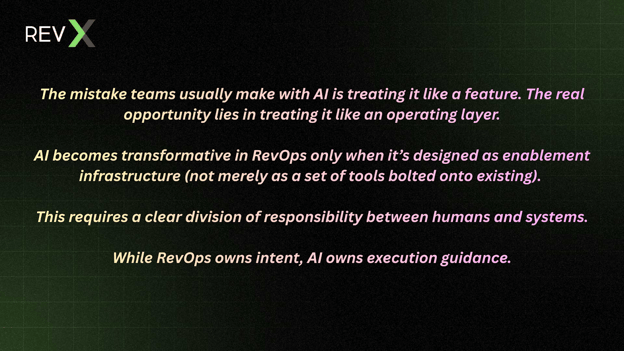
AI becomes transformative in RevOps when it functions as a shared enablement layer across sales and partnerships.
The real complexity in modern GTM lives at the edges, with channel partners, alliances, ecosystem collaborators, and co-sell motions. Internal teams can compensate for unclear guidance, but partners, unfortunately, cannot.
That’s why AI-driven enablement must extend beyond RevOps workflows and into partner operations.
The Operating Model Shift
While traditional enablement is centralized and static, AI-enabled RevOps and Partnerships operate on a different logic:
- RevOps defines intent, guardrails, and success criteria
- Partnerships define ecosystem priorities and incentive alignment
- AI distributes contextual guidance at the point of execution
Instead of pushing the same playbook to every partner, the system adapts guidance dynamically based on:
- Partner performance patterns
- Deal quality and conversion history
- Account maturity and engagement signals
- Expansion probability and retention risk
Now, your enablement becomes coordination.
Think about how ride-sharing platforms manage drivers. Drivers are independent operators who don’t sit in corporate offices or receive daily strategy briefings. Yet the system continuously guides them:
- Where demand is highest
- Which routes optimize earnings
- When to move to a different area
- How to maximize performance
The platform doesn’t micromanage drivers. Rather, just enables better decisions in real time.
Partner ecosystems function the same way. Without AI, RevOps and Partnerships attempt to manage distributed actors through static rules and reactive communication. With AI, the system guides partners toward:
- High-probability accounts
- Correct deal motions
- Aligned incentive paths
- Strategic segments the business prioritizes right now
Partners stay autonomous and alignment scales.
💡Here’s how to amplify conversions with our B2B partnership models for your business
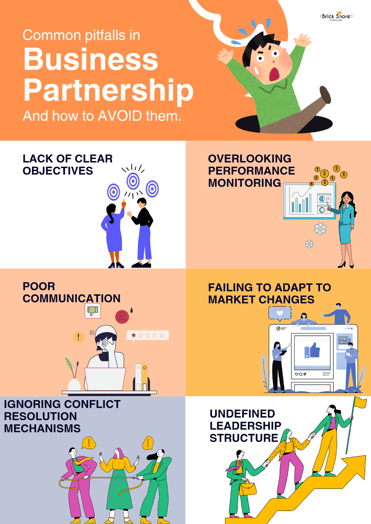
Source: Brick Shore
What does this mean for RevOps and Partnerships?
When AI becomes the enablement layer, RevOps shifts from workflow coordinator to system architect. Likewise, partnerships shift from relationship managers to ecosystem strategists.
Together, they design:
- Shared KPIs that unify internal and partner incentives
- Unified routing logic that prevents channel conflict
- Dynamic prioritization frameworks
- Embedded governance that reduces exception handling.
The Strategic Advantage
Often, organizations treat partnerships as merely an extension of sales. Keep in mind that the highest-performing ones treat partnerships as a distributed revenue network that requires system-level intelligence.
AI enables RevOps and Partnerships to scale judgment across that network without scaling overhead. The result is strategic consistency across every revenue actor.
Key takeaways: AI enables RevOps and Partnerships to operate as a coordinated system rather than parallel functions. When enablement becomes embedded and contextual, partner ecosystems scale without losing alignment.
The bottom line is, the next generation of RevOps leaders will design intelligent systems that guide partners, sellers, and operators with equal clarity.
The real question is whether your partner ecosystem will be enabled by a system or held back by manual coordination.