

 Salesforce
 HubSpot
 Claude
.png?width=58&height=58&name=Frame%202087327944%20(1).png) GA4
GA4
.png?width=58&height=58&name=Frame%202087327944%20(2).png) Marketo
Marketo
.png?width=58&height=58&name=Frame%202087327944%20(3).png) Audit Fox
Audit Fox
 Services


Revenue systems don’t fail all at once. Rather, they erode gradually. From being your source of reliability, it slowly turns brittle, even as dashboards continue to update and reports keep getting delivered.
Even when your team gets a feeling that something is off, the system still “works,” so the decay goes under the carpet.
This slow nature is the real danger of data decay. It shows up as hesitation in decisions, debates over numbers, and a growing reliance on manual fixes to keep things moving. Over time, trust weakens while effort increases.
Understandably, organizations respond by cleaning data more often and bank on more heroic intervention from RevOps. But decay isn’t caused by neglect alone, but also by the absence of a system designed to resist entropy in the first place.
Unfortunately, you can’t outwork decay. If data reliability depends on constant cleanup, the foundation is already unstable, and it raises a harder question about what’s actually holding your revenue engine together.
Why data decay is accelerating faster than teams can fix it
Data decay used to be gradual, but today, it compounds. As GTM systems expand, data changes more frequently, moves across more tools, and gets touched by more processes. Thus, every handoff becomes a chance of drift.
A useful way to think about data decay is through the lens of data entropy.
In complex revenue systems, disorder increases naturally unless countered by design. Every sync, manual fix, and system handoff adds a small amount of instability.
And data entropy is costly. Poor data quality alone costs the U.S. economy $3.1 trillion annually, eroding both ROI and competitive advantage.
As data complexity inevitably grows with scale, leading organizations are turning to data observability to manage entropy, gain visibility into data health, and refocus teams on value-creating work.
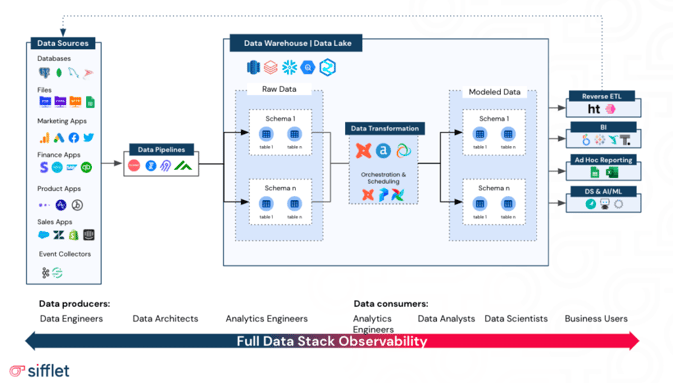
Source: Datatas
Over time, apart from being outdated, data becomes unpredictable. And without structure in place to absorb change, decay is inevitable.
The significant problem isn’t that teams stopped caring about data quality, because they do. However, the environment has changed. Modern revenue systems generate volume, velocity, and variability that manual processes were never designed to absorb to begin with.
Several forces accelerate decay at scale:
- Increased surface area: More tools, more fields, more integrations, more points of failure
- Constant change: Accounts, contacts, and buying groups evolve faster than system updates
- Asynchronous ownership: Data is created in one system, modified in another, and relied on somewhere else
- Delayed feedback loops: Errors often surface weeks after they’re introduced
This data decay easily hides behind your dashboards that still populate, reports that keep rendering, and KPIs that remain in action.
Teams usually respond by patching, as exceptions get handled case by case, and spreadsheets become the temporary truth. These interventions create the appearance of control while increasing fragility.
Over time, the cost shows up in slower decisions and defensive behavior. Leaders double-check numbers, and your teams lose precious time debating definitions. Thus, RevOps becomes the game of validating inputs rather than improving outcomes.
At this point, data decay turns into an execution constraint.
💡Discover how HubSpot-Salesforce integration boosts conversions through data analytics
Key takeaway: Data decay accelerates when complexity outpaces design. Without systems built to absorb change, teams end up maintaining data instead of trusting it.
The governance gap: when no one owns the data truth
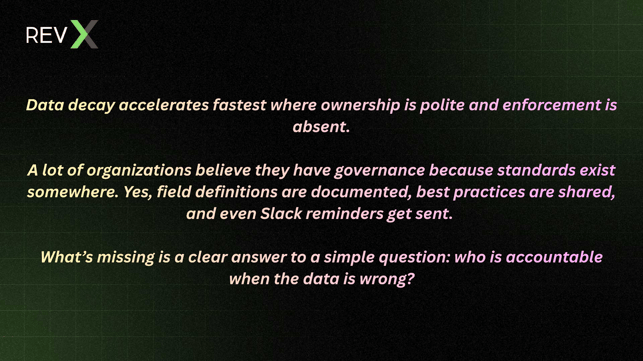
Ownership is fragmented across sales, marketing, finance (which owns reporting), and RevOps. Everyone touches the data, but no one owns its behavior end-to-end. So, accuracy is situational, not guaranteed.
💡Learn how AI in RevOps finally breaks organizational silos
A familiar scenario makes this painfully clear:
A CRO asks why pipeline coverage dropped for a key segment.
- Marketing points to firmographic filters.
- Sales flags misrouted accounts.
- Finance questions the timing of updates
- RevOps pulls the data and confirms something drifted weeks ago
It’s quite evident that no one can say exactly when or why. The issue didn’t belong to any single team, so it survived long enough to affect revenue. As a result, the meeting ends without a resolution.
This is the governance void in action, where problems come into the limelight only after damage is done.
What’s truly alarming is how reasonable it all feels when collaboration replaces accountability and consensus replaces control. Soon, governance becomes a social process rather than an operational mechanism.
Organizations stuck here lack structure more than intent. Until ownership is explicit and rules are embedded directly into workflows, data truth remains optional and decay remains inevitable.
Key takeaway: Data governance breaks down when truth has no owner. Without explicit accountability and enforced rules, accuracy becomes negotiable, and revenue systems inherit that instability.
How manual fixes become the biggest source of decay
It’s natural to think that manual intervention keeps bad data from spreading. In reality, it’s often what teaches the system to fail unnoticed.
Your manual correction bypasses the system that should have caught the issue in the first place. Over time, the stack learns the wrong lesson that mistakes will be cleaned up later.
Reality is (often disappointing, as Thanos would say 🥲), manual fixes don’t just patch data. Instead, they retrain behavior.
- When reps know errors will be corrected downstream, precision upstream stops mattering.
- When leaders accept “we’ll fix it in RevOps,” accountability dissolves.
Thus, your system becomes dependent on heroics more than design.
An unexpected consequence: The more effort teams invest in cleaning data manually, the harder it becomes to justify structural change.
While things look stable enough, pain is absorbed instead of surfaced. The organization unknowingly optimizes for resilience to bad data instead of preventing it.
A typical pattern follows:
- Data breaks gradually
- RevOps fixes it manually
- Confidence is temporarily restored
- Root causes remain untouched
- The next break happens faster
Eventually, decay accelerates because the system has been trained to rely on intervention rather than correction.
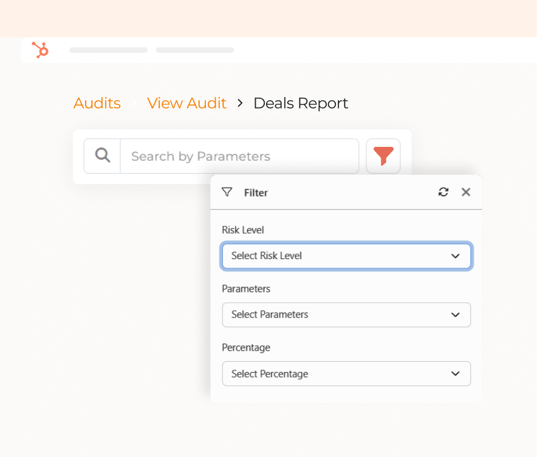
Thankfully, Audit Fox pulls hidden risks into the open, long before they turn into real damage.
It’s the HubSpot doctor that diagnoses the entire setup with a few simple clicks, finding the hidden issues that quietly break funnels, distort reporting, and drain productive time.
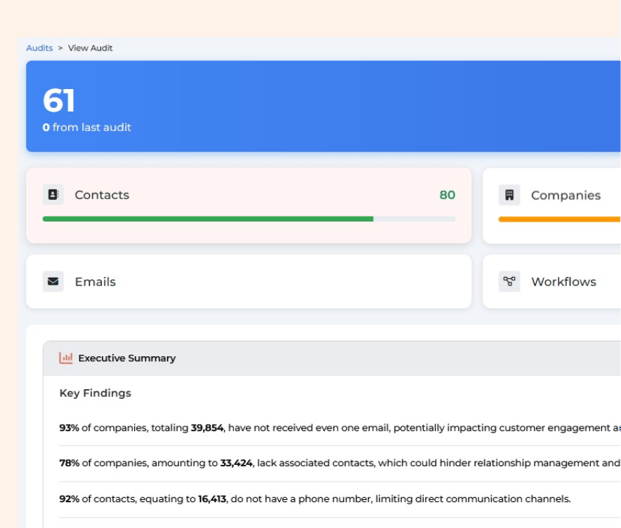
The good news is that, as a data audit tool, it prioritizes issues by risk, so you can focus on what actually matters, without wasting time on low-risk noise.
Key takeaway: Manual fixes hide decay. When cleanup replaces correction, organizations trade short-term stability for long-term fragility.
Designing governance as a revenue system, not a control layer
Gartner’s analysis suggests that through 2025, about 80% of organizations attempting to scale digital business will fall short due to outdated data governance.
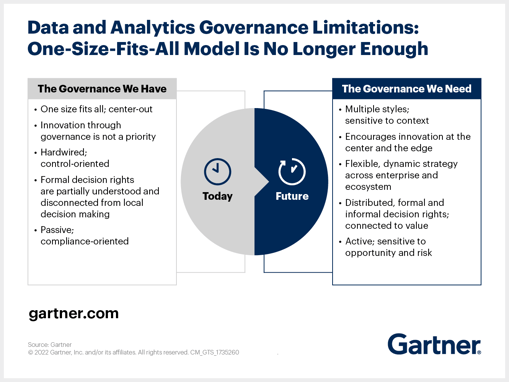
Adaptive data governance starts with clear principles that reflect the value and sensitivity of data and fit the organization’s culture. It requires explicit decision rights and accountability across business, data, and technology teams.
Governance styles should flex by use case, applying the right level of oversight for each scenario.
Finally, it must be embedded into the operating model, so governance decisions and their impact are understood and sustained across the organization.
Often, data governance efforts fail because they are built like policies. Smart revenue organizations build governance-like systems, and that’s where sustainable advantage is created.
The shift begins with a reframing: governance is more about containing entropy than preventing mistakes. After all, in dynamic GTM environments, decay is inevitable. The job of governance is to slow it, localize it, and correct it early, before it spreads.
Three concepts separate effective governance from performative governance:
1. Data ownership as behavioral accountability
Ownership only works when it extends beyond stewardship into consequences. Data management roles are important, but you, as a leader, must define ownership not by who is accountable for how it behaves downstream.
If inaccurate data causes routing errors, forecast noise, or misaligned incentives, the owner is responsible for redesigning the rule that allowed it.
2. Preventive controls over corrective cleanup
It’s normal for organizations to govern reactively. They detect issues after performance suffers.
Preventive governance flips the model by embedding rules at the moment data is created or changed.
Required fields, lifecycle movement, and qualification criteria are enforced structurally. Hence, the system stops bad data from progressing instead of asking humans to fix it later.
3. Local containment instead of global cleanup
Decay spreads when issues propagate unchecked across systems.
Effective governance isolates problems early. Anomalies are flagged close to their source, ownership is clear, and fixes happen before errors cascade into reporting, forecasting, or compensation models.
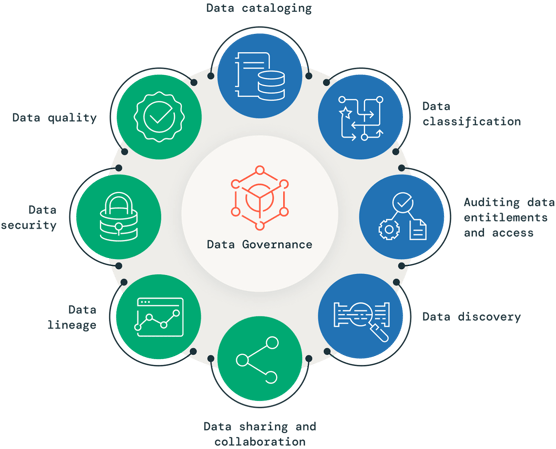
Source: Databricks
A situation-based contrast makes this tangible:
A company notices late-stage deals repeatedly slipping. In the old model, RevOps audits data weekly, sends reminders, and adjusts forecasts manually.
In the redesigned model, stage progression requires verified activity signals and timeline confirmation. If inputs drift, the deal simply cannot advance. Also, forecasts stabilize without additional reporting effort.
The insight here is subtle but powerful: governance doesn’t slow teams down, uncertainty does. When systems behave predictably, teams obviously move faster because they don’t need to validate or debate every time.
This is where RevOps becomes strategic and flexible by designing decision-safe environments where data reliability is the default state.
Also, importantly, governance shifts from being overhead and starts acting as infrastructure for scale.
Key takeaway: Data governance creates leverage when it is designed to prevent, contain, and correct decay automatically. Teams that build governance into the revenue system aren’t surprised by chaos as they’ve already accounted for it.
The bottom line is that data decay is a systems failure that only governance can correct. It can be overcome only by designing revenue systems where decay struggles to survive.
So, ask yourself, how much of your revenue engine is actually built to resist entropy, and how much is quietly relying on heroics to hold together.